

 1-877-817-6687


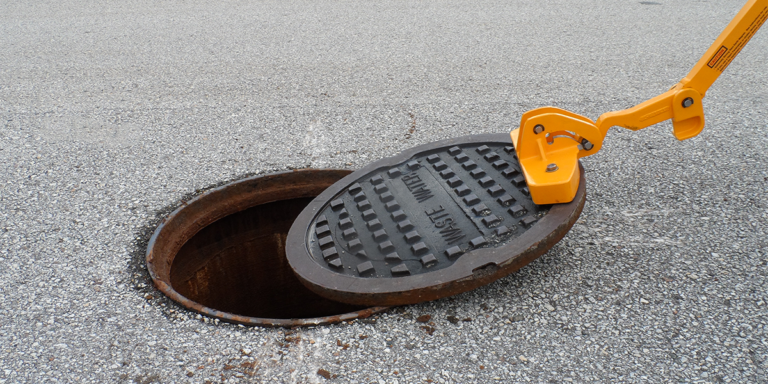
Every utility worker knows the drill: walk up to a manhole, wedge a hook bar into the pick hole, brace your back, and yank. It’s how covers have been moved for decades. It’s also how thousands of backs have been wrecked, fingers have been crushed, and workers’ comp claims have piled up on job sites across the country.
There’s a better way, and it’s a lot smarter than a steel bar.
The U.S. Saws Break ‘N Take and Robotron magnetic manhole lifter systems have changed the game for utility crews who open manholes day in and day out. If you’re still doing it the old way, here’s everything you need to know about why these tools exist, how they work, and whether they’re right for your crew.
The Problem: Manual Manhole Lifting Is a Back Injury Waiting to Happen
Manhole covers are not light. Cast iron lids commonly weigh anywhere from 90 to 250 pounds or more. When a worker reaches down, wedges a hook into a pick hole, and pulls upward (often at an awkward angle, in a traffic zone, or in wet conditions) their lower back bears the full brunt of that load.
Research makes this sobering: surveys show that 25% of workers who perform manual material handling experience back pain lasting more than 7 days annually, 14% require medical attention, and 10% need time away from work. Back injuries account for more than 38% of all work-related musculoskeletal disorders, and the Bureau of Labor Statistics has found that over one million workers suffer back injuries each year, representing roughly one-fifth of all U.S. workplace injuries.
NIOSH (the National Institute for Occupational Safety and Health) uses a mathematical equation to assess lifting risk, and manhole covers score poorly on nearly every factor: extreme load weight, low and awkward starting position, limited hand coupling, and frequent repetition throughout a shift. Manual manhole lifting isn’t borderline risky. It sits firmly in NIOSH’s high-risk category.
Beyond back injuries, the traditional method creates pinch-point hazards when the cover shifts unexpectedly, trip and fall risk as workers step backward with a heavy load, and fatigue-related incidents as the task repeats dozens of times across a workday.
How a Magnetic Manhole Lifter Works
The U.S. Saws Break ‘N Take and Robotron systems use rare earth neodymium magnets, among the most powerful permanent magnets available, to attach directly to the surface of the manhole cover. No pick holes required. No bending, no yanking.
The process has six simple steps:
Step 1 — Remove from the protective shoe. The tool is stored in a non-magnetic shoe that disrupts the magnetic field during transport, preventing it from unexpectedly latching onto metal surfaces on the job site. When you arrive at the manhole, you pull the tool from the shoe and place the magnet base on the outer edge of the lid. Wipe the magnet surface clean before placing it. Debris reduces holding capacity.
Step 2 — Break the seal. The “break” function is what makes this tool genuinely clever. With the magnet engaged, you lower the handle so the breaking arm contacts the ground, then gently press the handle with your hands — no forceful kicking, no body weight slamming — until the edge of the lid frees itself from its seat. The fulcrum acts as a lever, directing mechanical advantage down and under the lid edge.
Step 3 — Lift to standing position. Once the lid breaks free, you raise the handle to a comfortable upright position. At this stage, you’re not lifting the full weight of the cover. The tool is designed to tilt and lift only the edge, leveraging the lid up enough to slide it clear of the opening.
Step 4 — Drag to a safe location. With the lid free of the seat, you drag it backwards away from the opening. The tool stays attached. You lower the handle to the ground so it can’t tip over unexpectedly.
Step 5 — Release. To detach, lift the handle to its full upright position until it contacts the stopping pin, then push it against the stop in a quick, forceful motion. The magnets disengage, the tool tips back, and a sharp lift from the fulcrum fully releases it from the lid.
Step 6 — Return to the shoe. The tool goes back into the protective shoe for transport to the next location.
The Robotron operates similarly but uses a pivot-based three-position system — lifting, sliding, and removal — giving the operator more precise mechanical control at each phase of the operation. The Utility Robotron version adds an extendable handle, allowing taller operators or those who need extra working distance from the opening to operate even more comfortably.
Choosing the Right Manhole Lid Lifter: 3-Magnet vs. 4-Magnet, Standard vs. Utility
U.S. Saws offers the system in two product families across a capacity range from 150 lbs up to 325 lbs.
The Break ‘N Take is the entry-level system, offered in orange, and comes in two configurations:
- 3-Magnet (Part No. US30178): 150 lb capacity, 15 lbs unit weight, 10″ x 5″ base
- 4-Magnet (Part No. US30188): 225 lb capacity, 17 lbs unit weight, 10″ x 5″ base
The Break ‘N Take line is ideal for lighter residential or municipal covers that include standard water meter lids, smaller sewer access points, and utility vaults in lower-traffic environments.
The Robotron is the heavy-duty version, offered in yellow, with four configurations:
- 3-Magnet Robotron (US30178RT): 250 lb capacity, 15 lbs unit weight, 13″ x 6″ base, 34″ height
- Utility 3-Magnet Robotron (US30178UTILITY): 275 lb capacity, 19 lbs unit weight, 13″ x 6″ base, 42″ height
- 4-Magnet Robotron (US30188RT): 300 lb capacity, 18 lbs unit weight, 16″ x 7″ base, 34″ height
- Utility 4-Magnet Robotron (US30188UTILITY): 325 lb capacity, 22 lbs unit weight, 16″ x 7″ base, 42″ height
The difference between the standard and Utility versions is the handle: the Utility models have an extendable handle that raises the unit height from 34″ to 42″, giving taller workers a more ergonomic grip and giving crews in confined traffic zones extra distance between themselves and the open hole. For most municipal waterworks, wastewater, or telecom crews dealing with heavy cast iron street covers, the 4-Magnet Robotron at 300 lbs capacity covers the vast majority of real-world applications. The Utility 4-Magnet maxes out at 325 lbs for the heaviest infrastructure-grade covers found in high-load traffic zones.
One important note from the manual: the rated capacities are based on a clean, flat steel iron surface. Covers in the field will often be uneven or coated, which can reduce effective holding strength, so when in doubt, choose the higher capacity model.
One Worker. One Tool. Done.
Perhaps the most significant operational benefit of these systems is the manpower equation. A traditional hook bar or pry bar method for a heavy cover often requires two workers: one to lift the edge, one to guide or support the cover as it’s moved. With the Break ‘N Take or Robotron, a single properly trained operator can safely lift, slide, and reposition a manhole cover without assistance.
That changes crew sizing, especially for municipalities and contractors running tight field teams. Fewer workers needed for routine access means more people available for the actual work. On a crew that opens and closes dozens of manholes a day, the time savings compound quickly.
“One of our customers put it best — they said before the Robotron, every cover took two guys. Now one operator handles it solo, stays upright the whole time, and the second crew member is actually free to work. Over a week, that adds up to hours of recovered productivity. And nobody’s icing their back at the end of the shift anymore.” Brandon Utesch, Western Sales Manager, Water Works Division, U.S. Saws
Manhole Lifter Safety, Ergonomics, and OSHA Compliance
The manual is explicit about something important: the tool is designed to lift only the edge of a manhole cover so the lid can be slid off, not to suspend the full weight of the lid in the air. This is a deliberate safety design choice.
In terms of ergonomic improvement, the tool essentially eliminates the worst part of the manual method: the low-angle, high-load, awkward pull. Instead of stooping and yanking, the operator stands upright and uses controlled lever force. That directly addresses the posture, load weight, and coupling factors that make manual manhole lifting so risky under NIOSH guidelines.
There are a few safety factors crews need to be aware of:
- Magnetic field hazards: The neodymium magnets in these tools are powerful. The tool must be kept at least 36 inches away from persons with pacemakers or other medical implants; the magnetic field can interfere with device function, with potentially life-threatening consequences. Credit cards, electronic devices, and metal tools should also be kept clear.
- Pinch points: Strong magnets and ferrous metal create sudden, unexpected attraction forces. Workers should always be aware of their hands and feet when placing or removing the tool.
- Proper technique matters: Using sharp, jerky tugging motions during removal can cause the magnets to release unexpectedly. The manual recommends a stable body stance so that if the tool does release, the worker doesn’t fall backward.
- The tool does not replace the need for PPE: OSHA-compliant foot protection, eye protection, gloves, and appropriate clothing are all still required. What it does do is remove the highest-risk manual lifting component from a task that OSHA and NIOSH have long identified as a leading source of musculoskeletal injury in utility work.
“Training only gets you so far. The moment someone’s tired or running behind, all that proper lifting technique goes out the window. What actually protects workers is removing the hazard entirely — and that’s exactly what a magnetic lifter does. OSHA calls it engineering controls. We call it the right way to do it.” – Brandon Utesch, Western Sales Manager, Water Works Division, U.S. Saws
Which Industries Benefit Most from a Magnetic Manhole Lifter?
Any trade that regularly accesses below-grade infrastructure is a natural fit:
- Municipal water and wastewater utilities are the most obvious application. These crews open manhole covers multiple times per day, year-round. Reducing cumulative back stress for these workers has direct impact on injury rates and long-term workforce health.
- Electrical utilities maintaining underground distribution networks encounter similar covers and face the same lifting challenges.
- Road construction and paving crews often need to adjust cover elevations or access utility connections mid-project, frequently under traffic control conditions where speed and minimal crew disruption matter.
- Traffic zones are where this tool especially proves its value. In live traffic lanes, you don’t want workers bent over a cover for extended periods. The upright operating posture means the worker can keep eyes up, stay situationally aware, and complete the task faster.
Manhole Lifter Maintenance, Durability, and What to Expect Long-Term
The magnets themselves are a non-issue for maintenance. The system uses rare earth neodymium magnets, the same technology that has become standard across industrial applications, and these magnets do not lose their magnetic strength over time under normal use. There’s no battery, no hydraulic fluid, no motor. The magnet is the mechanism, and it’s effectively permanent.
Day-to-day care is straightforward: wipe the magnet faces clean before each use to remove dirt, asphalt residue, and debris that would reduce contact area and holding capacity. The protective shoe should be used every time the tool is transported to prevent unintended attraction to metal surfaces or other tools in the truck.
Beyond keeping it clean, inspect the handle joints and pivot points for wear, check that the stopping pin functions correctly and ensure the tool isn’t damaged or modified. Modifications void the warranty and, more importantly, can compromise the structural integrity of the lever system.
The one-year warranty covers defects in materials and workmanship under normal use. Given that the system has no consumable parts: no blades, no fluids, no electronics, the realistic service life of a well-maintained unit running daily in a utility crew environment is measured in years, not months.
The Bottom Line
The U.S. Saws Break ‘N Take and Robotron magnetic manhole lifter systems address a problem that’s been quietly grinding through utility workforces for generations: heavy covers, bad angles, and backs that give out years before retirement. The technology is simple: magnets, a lever, and good mechanical design.
The impact on crew safety, efficiency, and long-term health is significant.
If your crew is opening manholes regularly, the question isn’t really whether you can afford one of these. It’s whether you can afford not to have one.
View the full Break ‘N Take and Robotron lineup at U.S. Saws.