

 1-877-817-6687


If you’re filling concrete floor joints, you have two options for dispensing material: dual cartridges or a bulk joint filler pump. Both work. But they don’t work equally well at every scale, and choosing the wrong one for your operation costs you either money or opportunity.
In this blog, we break down how each method works, what it actually costs, and how to know when it’s time to make the switch.
How Cartridges Work
Dual cartridges are the entry point for most contractors. Each cartridge contains a pre-measured amount of Part A and Part B material in a side-by-side configuration. You load it into a dispensing gun, squeeze the trigger, and the two components mix through a static tip as they dispense into the joint.
The appeal is simplicity. No pump to set up, no lines to prime, no end-of-day flush. You buy what you need, use it, and move on. For small jobs or contractors who fill joints occasionally, cartridges are a practical, low-commitment solution.
The limitation shows up at scale. A standard cartridge holds 22 ounces and covers roughly 20 to 30 linear feet of joint depending on profile.
On a job with several thousand linear feet of joint, you’re loading and swapping cartridges constantly. It typically takes two people to maintain a continuous operation with one person squeezing, the other preparing the next cartridge. The work is slow, physically demanding, and the material cost per linear foot is significantly higher than bulk.
How a Bulk Joint Filler Pump Works
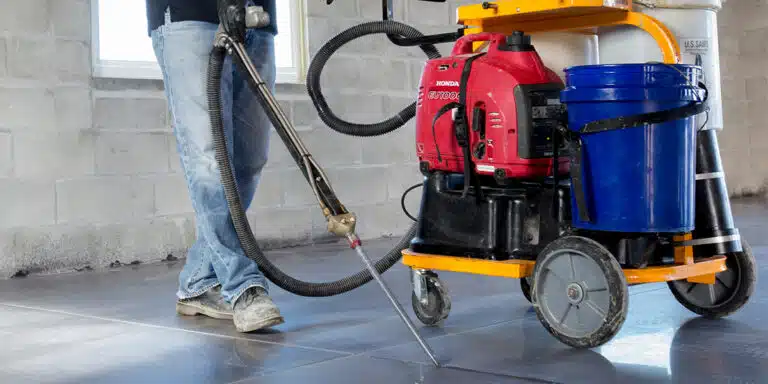
A bulk joint filler pump dispenses two-component polyurea or epoxy from large tanks rather than cartridges. Part A loads into one tank, Part B into the other. The machine pumps both components through separate lines to a manifold, where they combine and pass through a static mixer before dispensing into the joint.
The U.S. Saws One Man Polymer Pump runs at approximately 1 gallon per minute, allowing a single operator to cover 75 linear feet per minute on a well-prepared floor. A full 10-gallon load covers 600 to 700 linear feet. Where cartridges require two people working continuously, the One Man Pump is designed for solo operation — the T-handle lets one person control pump position with one hand and dispense with the other.
The tradeoff is the upfront investment and the learning curve. The machine costs $7,000 and requires proper setup, a daily maintenance routine, and an operator who understands how to run and clean it. For contractors who aren’t ready for that commitment, cartridges remain the right call.
The Math: Where Cartridges Stop Making Sense
This is where the decision gets clear.
On a 5,000 linear foot job with a standard joint profile, you need roughly 437 cartridges at $15 to $20 each. That’s $6,500 to $8,700 in material alone, not counting the labor of two people squeezing cartridges for the better part of a day.
The same job in bulk material runs significantly less per linear foot. Ten-gallon kits cost a fraction of the equivalent cartridge volume, and one operator running a pump finishes faster than two people working cartridges.
The crossover point varies by job size and material cost, but most contractors who do regular commercial floor work find the pump pays for itself within a handful of jobs. As Dave Glynn of U.S. Saws explains: “The cost of the machine to the contractor using it, on paper, eventually works out to be way less.” After payoff, every job done with bulk material is more profitable than the same job done with cartridges.
What Cartridges Do Better
Cartridges aren’t going away, and they shouldn’t. There are situations where they’re the right tool.
Small jobs with limited linear footage don’t justify the setup time and cleaning effort of a pump. If you’re filling a few hundred feet of joint in a tight space, cartridges are faster from a total-time perspective. Similarly, touch-up work, repairs in occupied facilities where mobility matters, or jobs where you only need the machine once make cartridges the practical choice.
Cartridges are also how most contractors learn the process. Understanding how the material mixes, cures, and behaves before operating a pump is valuable. The pump amplifies your production — but it also amplifies mistakes.
What a Pump Does Better
Volume. That’s the short answer.
A pump turns joint filling from a labor-intensive two-person operation into something one trained operator can handle efficiently. On large warehouse floors, tilt-up construction, distribution centers, or any project with thousands of linear feet of joint, the pump is the only way to stay competitive on price while maintaining margin.
The material savings compound over time. Bulk five-gallon kits cost less per unit of coverage than cartridges, and the savings add up across every job. Once the pump is paid off, that difference goes straight to the bottom line.
How to Know When You’re Ready to Switch
A few indicators that it’s time to look at a pump:
You’re regularly pricing jobs where cartridge material costs alone approach or exceed the cost of the machine. You’re turning down larger joint filling work because you can’t compete on price or timeline with cartridges. You’re spending more on cartridge material per year than the pump would cost. Or you’re putting two people on joint filling work when one should be enough.
The contractors who hesitate longest on the pump decision are often the ones spending the most on cartridges. The math tends to be more compelling than expected once you run it on your actual job history.
As Dave Glynn of U.S. Saws puts it:
“When you go from cartridges to a pump, it’s a game-changer.”
The Right Pump for the Job
For contractors ready to move to bulk dispensing, the U.S. Saws One Man Polymer Pump (SX20552) is built for solo commercial floor work. It handles both polyurea and epoxy joint fillers at 1:1 ratio, runs on standard 115V power or cord-free with a generator or battery and inverter, and is backed by U.S. Saws’ technical support and distributor network.
For operations running larger crews where a two-person pump team makes sense, the U.S. Saws Dual Component Pump (SX20150) covers the same applications at a slightly lower price point.
For a full breakdown of how the One Man Polymer Pump works and what it costs to operate, read our complete guide: The One Man Polymer Pump: A Joint Filler Pump Built for Real Production.