

 1-877-817-6687


In demanding utility environments, crews rely on innovative construction equipment designed to perform where traditional tools fall short.
Concrete hand saws — including air-powered and hydraulic-powered models — are engineered for precision, control, and safety on the job.
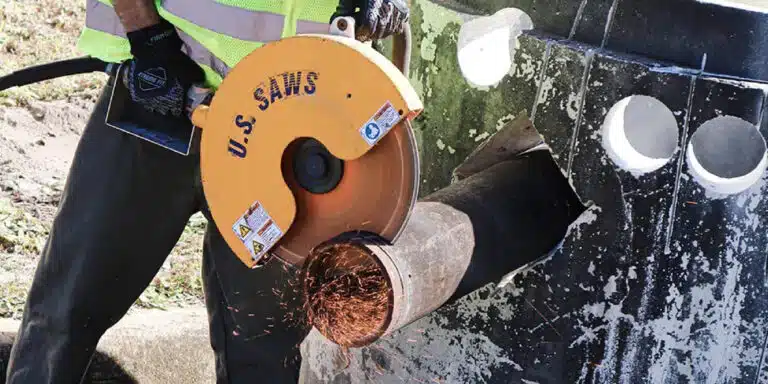
These portable saws are built for cutting concrete, masonry, and ductile-iron pipe in environments where traditional gas tools may pose risks or limitations.
Whether working in confined spaces, cutting pipe in trenches, or making deep cuts in reinforced concrete, these hand-held saws deliver the versatility and durability contractors in the utility and infrastructure industries depend on every day.
In this blog, we explore how air-powered and hydraulic hand saws are used in utility and construction applications, the benefits of each design, and what to consider when selecting the right saw for your next project.
What Is a Hand-Held Saw?
A hand-held saw is a portable concrete cutting tool designed for jobs where control and maneuverability matter as much as power. Unlike walk-behind saws or wall saws, a hand held saw allows operators to make vertical or overhead cuts, work in tight trenches, and complete precise openings without large equipment. These saws are frequently used by utility and municipal crews performing water-main, sewer, or repair work, where the ability to operate safely in damp or confined environments is essential.
Air-Powered Hand-Held Saws
Air-powered saws like the U.S. Saws HS-125 provide a clean, spark-free alternative to gas-powered chop saws. Powered entirely by compressed air, they emit no exhaust fumes and require minimal maintenance.
Typical applications include:
- Cutting concrete or ductile-iron pipe in trenches or vaults
- Performing interior or confined-space cutting where ventilation is limited
- Utility or wastewater work where electrical or fuel ignition risks are present
Because compressed air keeps the motor cool and prevents sparking, air-powered saws are a reliable choice for underground and municipal projects. They’re lighter than many hydraulic units, start instantly, and can be paired with diamond blades designed for fast, smooth cuts.
Hydraulic Hand-Held Saws
Hydraulic-powered saws, such as U.S. Saws’ 24-inch Hydraulic Hand Saw, are engineered for heavy-duty concrete and pipe cutting. Driven by a separate power unit supplying pressurized hydraulic fluid, these saws deliver exceptional torque and blade speed for demanding applications.
Key features include:
- Fully welded aluminum frame for durability
- Dual-position front handle for control
- Up to 10-inch cutting depth for deep concrete or masonry work
- High-efficiency motor operating at 12 GPM @ 2500 PSI
Hydraulic hand saws are ideal for water- and sewer-line installation, structural concrete removal, and deep utility access cuts. They excel in wet environments because they use water for cooling and dust suppression while operating safely without electricity or exhaust.
Choosing the Right Blade for a Concrete Hand Saw
Performance depends as much on the blade as on the saw itself. U.S. Saws manufactures a range of diamond blades engineered for professional cutting.
When selecting a blade, contractors should consider:
- Material type: Harder bonds for abrasive materials like concrete and asphalt; softer bonds for dense materials like tile or stone.
- Cutting style: Segmented blades for aggressive speed, turbo-rim designs for balanced control, and multi-purpose blades for mixed materials.
- Wet cutting: Always recommended for concrete and masonry to reduce heat, extend blade life, and control silica dust.
- Wet-cutting practices are especially important for safety and compliance. For additional guidance, see The Do’s and Don’ts of Wet Tile Cutting with Diamond Blades
Safety and Best Practices
Operating a concrete hand saw safely requires attention to both environment and equipment.
Contractors should:
- Verify that guards, hoses, and couplings are secure before starting.
- Match blade RPM ratings to the saw’s operating speed.
- Use continuous water flow when wet cutting to minimize airborne silica.
- Inspect hydraulic hoses or air lines for wear or leaks.
- Wear PPE — safety glasses, gloves, hearing protection, and respirators.
Follow OSHA’s Hand and Power Tools safety guidance for proper training and tool inspection.
By adhering to these steps, crews can improve productivity while meeting job-site safety standards.
Why Contractors Choose U.S. Saws
For more than 30 years, U.S. Saws has developed specialty cutting equipment that meets the real-world needs of construction and utility professionals. The company’s air-powered and hydraulic concrete hand saws combine portability, torque, and safety features that allow crews to work efficiently in challenging conditions.
Many models are manufactured in the U.S.A. and supported by product training, on-site demonstrations, and customer service from experts with decades of field experience.
Explore the complete selection of hand-held concrete saws and diamond blades at U.S. Saws to find the right tool for your next project.