

 1-877-817-6687


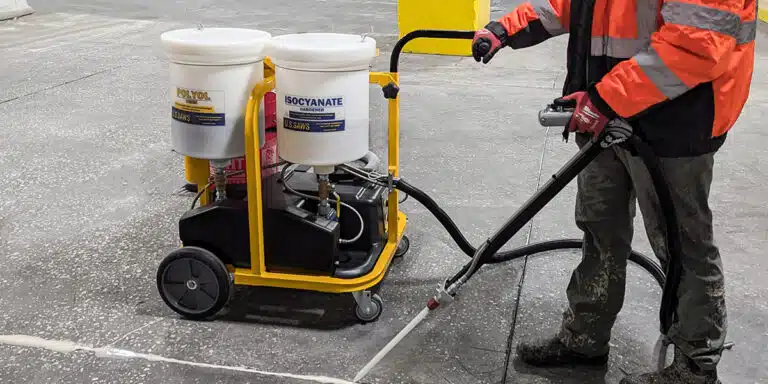
A joint filler pump is a significant investment. The U.S. Saws One-Man Pump runs $7,000 — and with proper maintenance, it can last years of regular commercial use. Without it, you’re looking at a $1,000 repair bill per side, or worse, a machine that’s down when you need it most.
In this blog, we cover everything you need to know about joint filler pump maintenance: daily cleaning, overnight storage, what to do when something goes wrong, and how long the machine’s components are designed to last.
The Biggest Mistake Operators Make
Skip the end-of-day purge cycle. That’s it. That’s the one thing that takes a well-running machine and turns it into an expensive problem overnight.
When polyurea or epoxy material is left in the lines without flushing, it cures solid — from the tank through the pump, through the lines, all the way to the tip. Replacing everything on one side runs close to $1,000 in parts, plus labor. Compare that to the 15–20 minutes a proper end-of-day flush takes, and the math is straightforward.
It happens because operators finish a job, they’re tired, they think the machine will be fine until tomorrow. Sometimes it is. Eventually it isn’t.
The Daily Flush Protocol
When you’re done for the day and not returning to the same job tomorrow, here’s the correct process:
- Step 1: Remove remaining material. Drain any leftover joint filler from the tanks back into your containers.
- Step 2: Add solvent. Pour approximately half a gallon of xylene or mineral spirits into each tank. Both work well — those are the two recommended solvents for this application.
- Step 3: Scrub the tanks. Use a toilet bowl brush on each side to clean the interior tank walls while the solvent is in there.
- Step 4: Cycle the solvent through the system. Disconnect the pump lines from the manifold and redirect them back into the tanks. Run the machine so solvent flows from the tank, through the pump, through the lines, and back into the tank. This emulsifies any remaining material throughout the system.
- Step 5: Dump and check clarity. Pump the used solvent out for proper disposal. Add a fresh half-gallon of clean solvent and run it through again. When the solvent coming out runs clear, the system is clean. If it’s still cloudy, run a third pass — don’t skip it.
- Step 6: Purge with oil. Wipe down the tank interiors with a rag, then slowly pump hydraulic oil through the entire system until it comes out the tip. This pushes out any remaining solvent and leaves the lines protected. Run a couple of seconds of pure oil out the tip, and the machine is ready to store.
For hydraulic oil, 32-weight or 45-weight works fine — ISO 32 or AW 46 are the same thing by different naming conventions. Available at any auto parts store. U.S. Saws doesn’t sell it because it doesn’t need to be anything special.
The whole process takes about 15–20 minutes. That’s the trade-off against a $1,000 repair.
If You’re Coming Back Tomorrow
If the machine is going back to the same job the next day, you don’t need to do a full flush. Fill the tanks to the top and cover the material with plastic sheeting to keep oxygen out. The key step on the polyurea side: pump white lithium grease into the manifold grease fittings. This blocks the orifices so no material seeps out and — more importantly — no oxygen contacts the isocyanate overnight. Isocyanate and air is how you wake up to a clogged manifold.
This overnight method works reliably when it’s done correctly. The operators who run into trouble are the ones who skip the grease or the plastic and assume the machine will be fine.
The Static Mixer Is Disposable — That’s by Design
The static mixer at the tip is meant to be thrown away. Operators will go through several per day on a production job, and that’s expected. They’re not expensive and they’re not meant to last.
Where clogging becomes a real problem is upstream: the manifold, the lines, the fittings, and the pumps. Good daily housekeeping handles most of it. The static mixer is a sacrificial part that protects the more expensive components behind it.
When the Manifold Clogs Anyway
Even with good maintenance habits, manifold clogs happen eventually.
As Dave Glynn, Owner of U.S. Saws, explains:
“That is not a situation of if it happens, but when it happens. Professionals keep a spare manifold on hand the same way they keep a spare tire. A replacement manifold runs around $170.”
When a clog occurs, U.S. Saws tech support will walk operators through a cleaning procedure. Whether that saves the manifold depends on how bad the clog is. In many cases the answer is to clean what you can, order a replacement, and get back to work. Trying to fully rebuild a clogged manifold while it’s sitting in a van is usually not worth the time.
Pump Longevity: What to Expect
The pumps in the One-Man Pump are custom-built for this application — not off-the-shelf hydraulic components. U.S. Saws worked directly with the manufacturer to address failure modes specific to joint filler materials, including a sealed bearing design and repositioned seal that prevent isocyanate from migrating into the bearing under back pressure.
With consistent maintenance, the pumps last approximately 5,000 gallons of material before wearing to the point of reduced output. The wear is gradual — the abrasive nature of the resin slowly wears the gear tolerances, and eventually the pump doesn’t move material as fast. At 10 gallons per load, 5,000 gallons is 500 full loads. For most commercial operations, that’s years of regular use.
When a pump does need replacement, it’s a shop job — not a jobsite repair. Plan for 20–30 minutes to remove the pump from the machine, then one to two hours of bench work to rebuild the seals, not counting time to remove cured material if the pump wasn’t properly maintained. Most operators find it’s cheaper and faster to swap in a new pump than to rebuild, since the cost of the pump is often less than the labor to fully restore one that’s been neglected.
The rest of the machine — frame, tanks, lines, fittings — is built to outlast the pumps by a wide margin.
Other Components to Watch
- Seals: Run them until they show signs of leaking, then replace. Seal replacement is a shop job requiring a vise and ideally a small press.
- Hoses and lines: Replace when they show wear or start leaking. Keep spares on hand.
- Tanks: The semi-transparent polyethylene tanks are inexpensive to replace and straightforward to swap out. If a tank gets damaged or heavily stained, replacement is easier than most operators expect.
The Bottom Line on Maintenance
The One-Man Pump is a low-maintenance machine when it’s treated right. There’s no complex weekly service schedule. The daily flush protocol is the entire program — do it consistently and most operators will never deal with a serious mechanical issue.
The problems come from skipping steps. One night of uncured material in the lines can cost more than a month of proper maintenance time. Professionals treat the end-of-day flush as non-negotiable, keep a spare manifold on the truck, and pre-measure jobs so they’re never running dry mid-floor.
For parts, technical support, or maintenance questions, contact U.S. Saws directly. The team that built the machine is the same team that answers the phone.