

 1-877-817-6687


If you’re still filling concrete floor joints with hand-squeezed cartridges or running a two-man pump operation, you’re leaving money on the table. The U.S. Saws One Man Polymer Pump (SX20552) is a dual-component joint filler pump designed for one-person operation — and once contractors run the numbers, most don’t go back.
In this blog, we discuss how the One Man Polymer Pump works, what makes it a true one-person operation, the production numbers contractors can expect, and why the machine pays for itself faster than most expect.
How the One Man Polymer Pump Works
The One Man Polymer Pump is straightforward in concept. Part A resin loads into one 6.5-gallon tank, Part B into the other. The machine pumps both components down through separate lines to a metal manifold, where they meet and are channeled into a disposable static mixer. By the time the material reaches the tip, it’s thoroughly combined and ready to inject directly into the joint, where it cures solid.
Setup from unpacking to first dispense runs about 30 minutes once an operator gets comfortable with the machine — less for experienced crews. The pump handles polyurea and epoxy joint fillers at 1:1 ratio, and will also dispense certain polyaspartic coatings. It is not compatible with silicone sealants.
What Makes It a One-Man Operation
The “T” handle is the key. It’s designed for both left- and right-handed use, positioned so the operator can pull the cart along with one hand while controlling the dispense handle with the other. That’s it — one person moves the machine and controls material flow simultaneously.
The practical result: the rest of the crew stays productive on other tasks instead of shadowing the pump operator. And because the operator always knows exactly where the pump is relative to freshly filled joints, there’s no risk of rolling back over wet material — a real problem with traditional two-man setups.
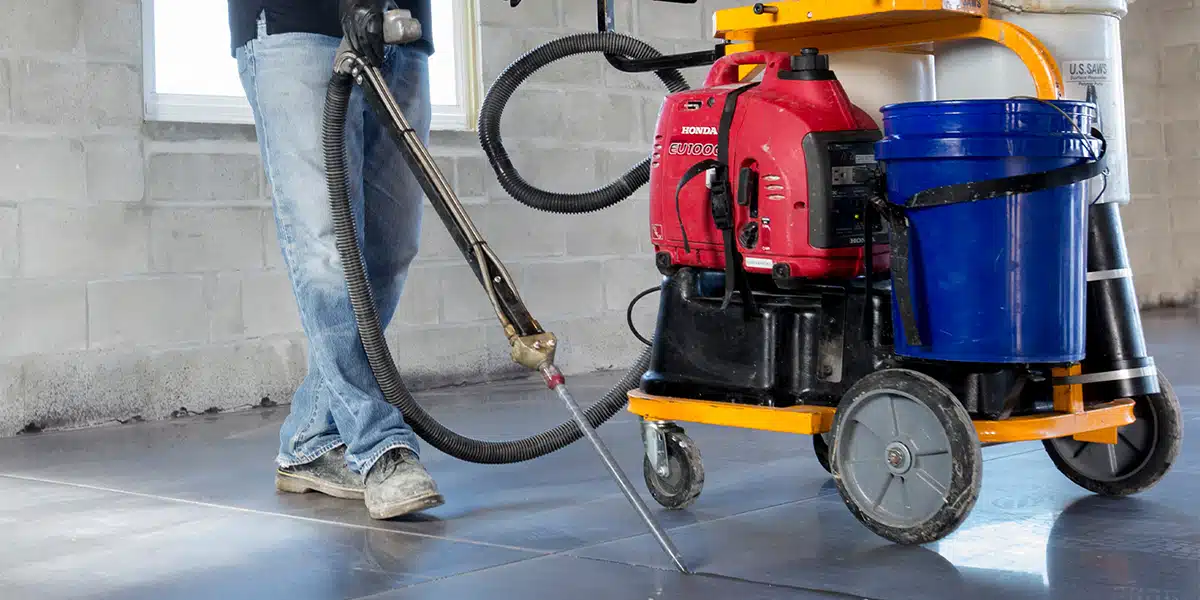
The strapped-on waste bucket takes care of another common headache. Instead of dripping uncured resin across the floor while repositioning between joints, the operator holds the mixing tip over the bucket during transit. No material on the floor, no cleanup with acetone and rags.
At 175 lbs, the machine isn’t a one-man lift — but that’s not how it’s typically moved. Most operators roll it up a tilt-down trailer ramp, which a single person can handle without help. Once it’s on the floor, the four-wheel design maneuvers easily.
A Joint Filler Pump And The Numbers That Matter
On a well-cleaned joint in open space, one operator can walk the machine at 75 feet per minute while dispensing. As Dave Glynn, Owner of U.S. Saws puts it: “One guy on a well-cleaned joint that’s in a wide-open space can walk with the machine at about seventy-five feet per minute while it’s dispensing.” The machine’s flow rate is approximately 1 gallon per minute, which keeps pace with that walking speed without over-applying material.
For material coverage, the math works out to roughly 600–700 linear feet per 10-gallon load on a standard joint profile (1.5″ deep × 0.187″ wide). The 6.5-gallon tanks hold a full 5-gallon bucket of material per side with reserve — so operators aren’t stopping to refill the moment a bucket runs dry. They load a full pail, run until they see the level dropping, and have time to prep the next bucket without a hard stop.
A good contractor pre-measures joint depth and width on a test section before ordering material, then adds a buffer. Excess carries to the next job. No one gets caught short mid-floor.
Polymer Pump Power Options
The pump runs on 115V standard power. On most commercial jobsites, that means running a cord — workable, but not always ideal across a large warehouse floor.
The more popular setup is cord-free: the machine’s built-in storage space fits either a Honda EU1000i, a Predator 2000 generator, or a deep-cycle battery paired with an inverter. If you’re going the battery route, a Group 27 Deep Cycle Battery is the recommended spec — the unit does not come with a battery, and U.S. Saws will install the inverter for you if requested at the time of order. Battery-and-inverter operation is particularly useful in occupied facilities where generator exhaust or noise is an issue. A 220V version is available as a special order for operations that need it.
Built-In Design Details That Save Time
Several features on the SX20552 address specific field frustrations that operators of older pump designs will recognize immediately.
The two-position wand holder has a standard operating position and a dedicated cleaning position — a small thing that makes end-of-day maintenance faster and more consistent. The redesigned diamond head manifold makes line removal easier, which matters when you’re doing a proper daily flush. The three-bolt pump change system means faster service when a pump needs to be swapped in the field.
The semi-transparent polyethylene tanks let operators monitor fluid levels on the fly without stopping to check. Removable debris screens protect the pumps from contamination, and the tanks are inexpensive to replace if needed. The spill cover over the motor protects both the machine and the floor from dripped or spilled material during operation.
The ROI Case For the One Man Polymer Pump
The pump lists under $7,000. That number gives some contractors pause — right up until they run the math.
Hand cartridges typically cost $15–20 each and cover around 20–30 linear feet. On a 5,000-foot job, that’s hundreds of cartridges and thousands of dollars in material cost alone, plus the labor of two or more people squeezing tubes all day. Bulk 5-gallon kits — what the One Man Pump is designed to run — cost significantly less per unit of coverage.
The crossover happens faster than most expect. After a few thousand linear feet of joint, the difference in material cost alone begins to offset the machine purchase. After that, the labor savings are pure margin. Contractors who do regular commercial floor work typically see payback within a handful of jobs.
A Polymer Pump Built to Last
The pumps inside the SX20552 aren’t off-the-shelf hydraulic components. U.S. Saws worked directly with the pump manufacturer to custom-build them for this specific application — addressing failure modes common in standard hydraulic pumps when running polyurea and epoxy materials. The result is a pump that handles the shear-thickening properties of these materials without the restriction and buildup issues that plague generic designs.
With proper maintenance, the pumps last approximately 5,000 gallons of material before wearing to the point of reduced output — roughly 500 full loads, which translates to years of regular use for most operations. The frame, tanks, and lines are built to outlast the pumps by a wide margin. The machine carries a one-year warranty against defects in material and workmanship under normal use.
Maintenance Keeps the Machine Profitable
The biggest mistake new operators make is skipping the end-of-day purge. Leaving material in the lines overnight without flushing can result in a fully cured system from tank to tip. Replacing everything on one side runs close to $1,000 in parts plus labor — far more than the 15–20 minutes a proper flush takes.
That maintenance protocol, and what it actually involves, is covered separately in our guide to cleaning and maintaining the One Man Polymer Pump. Doing it right consistently is the difference between a machine that lasts years and one that becomes an expensive problem.
Who Is the One Man Polymer Pump For
The One Man Polymer Pump is built for commercial and industrial floor contractors doing regular joint filling work — warehouse floors, distribution centers, manufacturing facilities. An optional 2:1 sprocket kit is available for materials requiring that mix ratio.
It’s not the right tool for a contractor doing occasional small jobs who hasn’t yet built volume. For those situations, cartridges are still practical. But for anyone filling joints as a regular part of their business, the pump pays for itself and then keeps paying.
The machine is backed by U.S. Saws’ technical support and a network of distributors nationwide. For questions, specs, or to place an order, contact U.S. Saws directly.