

 1-877-817-6687


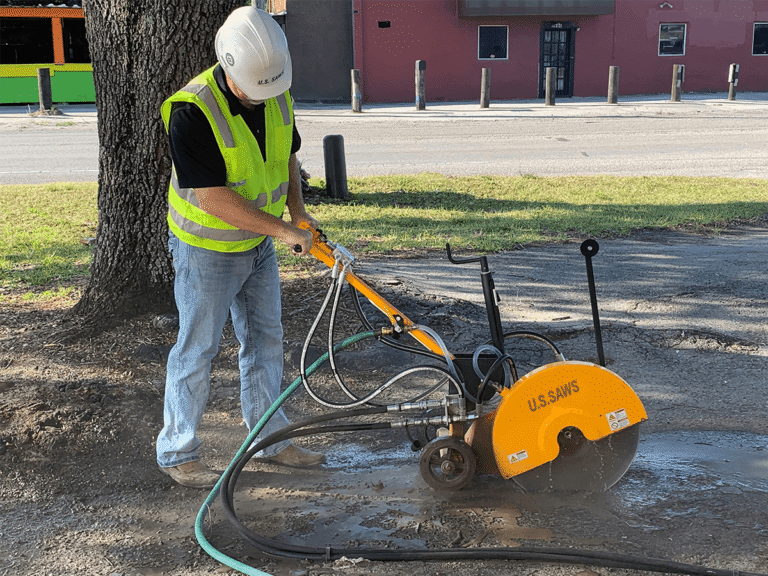
When a job calls for deep, straight cuts in concrete or asphalt but a gas saw can’t run safely (indoors, in a trench, anywhere exhaust is a hazard), the FSB-150 and FSB-150H are the two saws to reach for.
Both are fume-free and cut in water. Mechanically they are almost identical: 144 pounds, a 7.5-inch maximum depth of cut, 3,300 RPM, up to a 20-inch blade, and a geared direct drive with no belt to slip.
So what’s the difference? It comes down to the power running the saw, and which power source your crew already has on the truck.
The number one call we get is from crews who need to cut inside a building or down in a trench where a gas saw simply can’t go safely… Brandon Utesch, Sales Manager for Western Territory
Side by Side
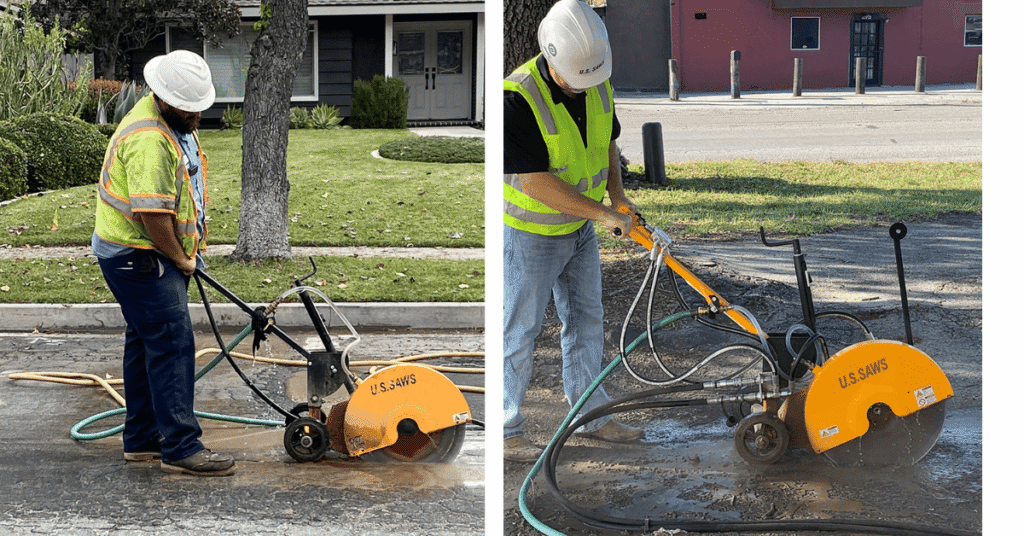
The two are identical on paper except for the power source and the hydraulic model’s flush-cut blade capacity.
| Spec | FSB-150 (Air) | FSB-150H (Hydraulic) |
|---|---|---|
| Power source | Air compressor (pneumatic) | Hydraulic power pack |
| Power requirement | 90 CFM @ 90 PSI | 12 GPM @ 2,500 PSI |
| Weight | 144 lbs | 144 lbs |
| Max blade diameter | 20″ | 20″ (flush cut) |
| Max cutting depth | 7.5″ | 7.5″ |
| RPM | 3,300 | 3,300 |
| Drivetrain | Geared, no belt slip | Geared, no belt slip |
| Part number | US60050 | US60050-H |
The FSB-150 (Air): Pros and Cons
The air saw runs on a standard compressor at 90 CFM and 90 PSI.
Pros
- Runs off a standard air compressor (90 CFM at 90 PSI), common rental and fleet equipment that is often already on site for other pneumatic tools
- Lower purchase price
- No hydraulic hoses, fittings, or fluid to maintain or leak
- Simpler and generally cheaper to service, with fewer wear parts
Cons
- Needs a large compressor (90 CFM sustained), which adds a second piece of equipment, more power draw, and more noise on site
- Line losses over distance or through long hoses can reduce effective air delivery and cutting power
- Less common on sites that have standardized on hydraulic power packs for their other tools
The FSB-150H (Hydraulic): Pros and Cons
The hydraulic saw runs off a power pack at 12 GPM and 2,500 PSI through quick-connect fittings.
Pros
- Runs off a hydraulic power pack (12 GPM at 2,500 PSI), standard on many utility, water and sewer, and demolition crews that already run hydraulic breakers, drills, or chain saws, so one power source feeds several tools
- Power delivery tends to stay more consistent under load, which means better stall resistance in tough or reinforced material
- Quick-connect fittings make hookup and tool swaps fast
- No compressor noise and no compressed-air lines to run
Cons
- Higher up-front cost
- Requires a hydraulic power pack sized to 12 GPM and 2,500 PSI, a significant added cost if the crew does not already have one
- Hoses, seals, and fluid have to be kept clean and leak-free, and cold, thickened fluid can affect performance
- Slightly more specialized maintenance
Which One Belongs on Your Truck?
It mostly comes down to the power you already run. A crew with an air compressor and other pneumatic tools gets a lower-cost saw with no added capital outlay. A crew already running hydraulic breakers or drills gets a saw that shares that power pack and holds cutting power more consistently under load, at a higher up-front cost. Everything else is the same: both are fume-free, water-safe, vibration-reduced, and lighter alternatives to gas-powered walk-behind saws for sidewalk, trench, street, and utility repair.
The Bottom Line
Both saws make the same cut, so the decision really comes down to which power source is already on your truck. Match the saw to what you already run, and neither choice is wrong.
If your trucks already carry a 90 CFM compressor, the FSB-150 is the easiest decision you’ll make all year…
Bill Glynn, President of Water Works Sales