The TC-7 Stand-Up Concrete Edge Grinder: Better Edges Without the Knee Pain

Edge grinding is one of the most visible parts of any concrete floor, and it is also the part that punishes the crew the most. Edges sit right where everyone looks, so when they are off, they stand out.

The pros who do this work take real pride in a clean finished floor, which means subpar edges are never acceptable. The problem is that getting great edges the traditional way is brutally labor intensive. You are on your hands and knees, hunched over for hours, putting heavy strain on your knees and your back. Even the best operators usually hold full production speed for only the first few hours before fatigue takes over.

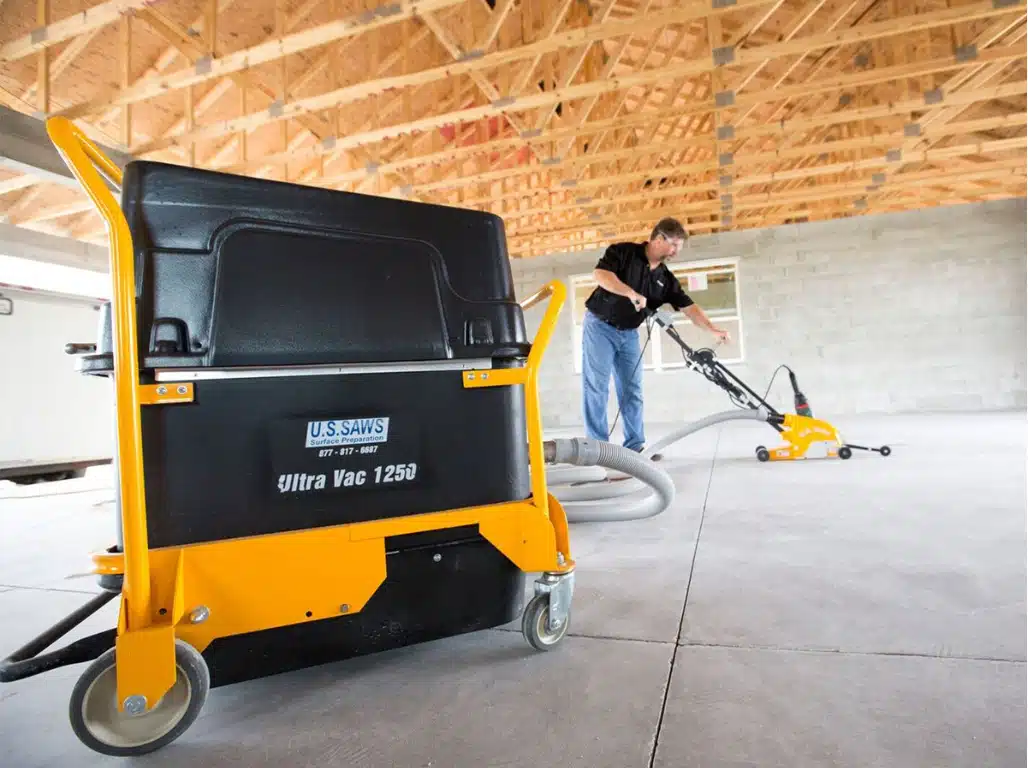
The TC-7 was built to solve that problem. It is a stand-up concrete edge grinder that keeps the operator upright and comfortable while delivering the feel and precision of a handheld grinder.

In this blog, we explore what makes the TC-7 concrete edge grinder different and where it fits on the job. You will learn how the stand-up design protects your crew from fatigue and injury, how the on-the-fly pitch and side-to-side controls give it the feel of a handheld grinder, how the Generation 2 dust shroud keeps the work area clean, and how one concrete edge grinder can switch between aggressive grinding, fine polishing, and coating removal.

Why Concrete Edge Grinding Punishes Crews

The cost of hand grinding is not just slow production. It is the physical toll. Kneeling, bending, and reaching for hours forces crews to stop often to stretch, hydrate, and recover.

Every one of those breaks is time the floor is not getting ground. A handheld grinder might be fast in short bursts, but those bursts get shorter as the day goes on. By mid-afternoon the same edge that took one pass in the morning can take two.

Our customers tell us the biggest gains from the TC-7 are not just speed, they are consistency. Hand grinding might be quick in short bursts, but it is physically punishing, and crews naturally take frequent breaks to stretch, hydrate, and recover before getting back down on their knees. That downtime adds up fast. With the TC-7, operators stay comfortable and stay working, so the machine runs all day instead of in stops and starts. One contractor told us his crew actually competes over who gets to run it, and he is already planning to buy a second unit.

Dave Glynn, VP of Surface Prep Sales, U.S. Saws

How a Stand-Up Edge Grinder Changes the Job

The U-shaped frame is the heart of the design. It lets the operator stand upright and stay close to the tool, with no reaching out over a frame to get to the controls. That upright stance is more comfortable, more intuitive, and gives a far better feel for what the grinder is doing on the floor. Instead of fighting fatigue, the operator stays in a natural working position and keeps moving.

Total Control, Not Just Convenience

A rear pitch-adjustment lever and a front side-to-side handle let the operator change pressure instantly while grinding. That is what on-the-fly adjustment means on the job: you keep consistent contact with the floor without stopping or wrestling the machine. The TC-7 feels like a hand grinder because the design feeds operator feedback directly from the cup wheel and the surface it is grinding. Solid tie-rods connected to ball joints on a unique grinder mounting bracket make that possible. No other machine on the market has matched it. This is real engineering, not marketing.

Built for Tough Job Sites

The whole machine is built to take abuse. A durable aluminum chassis keeps the weight manageable, heavy-duty casters roll over cords and debris instead of catching on them, and a shock-absorbing grip protects the operator. Solid components sit on an easy-to-maintain platform, so the TC-7 holds up to daily job-site punishment.

Power Behind the Concrete Edge Grinder

The TC-7 runs on the proven Metabo W24-230, a 15-amp grinder that delivers 6,600 RPM with plenty of power. That grinder has been the industry standard for more than thirty years. To make the stand-up design feel familiar, the handle was separated from the grinder body and moved to the top of the frame, so the operator gets the same trigger and lock as the handheld version. The result is a concrete edge grinder that feels like a tool the crew already knows.

Generation 2 Dust Shroud for Cleaner Edge Grinding

The Generation 2 dust shroud is made from a proprietary polyurethane. It is hard enough to resist wear but soft enough to flex over imperfections in the floor. The front edge flips up to expose just enough of the cup wheel to get tight against the wall, while still sealing between the shroud and the wall to capture dust. The hose port sits low to the ground and connects to a standard dust extraction vacuum, so the operator is not dragging the weight of the hose around. The hose lays flat and follows the machine, which matters because concrete edge grinding happens in small, rapid movements. A cleaner work area supports crew health and helps you stay within OSHA’s respirable crystalline silica standard on the site.

More Than Edges: Where the Concrete Edge Grinder Shines

The TC-7 is built for small rooms, garages, kitchens, bathrooms, and anywhere a large planetary grinder cannot fit. It is especially useful for polishing, where the same edges often have to be run multiple times. On long straight runs in a standing position, each pass gets faster because the operator is not fighting fatigue. It also handles long straight edges on larger jobs with ease.

Edge Grinding and Polishing Versatility

The TC-7 runs 7-inch cup wheels, ceramics like the Boride EZ Edge pads, and ZEC wheels, and it switches to polishing pads with an optional variable speed controller. The controller is an add-on that can be installed later or removed easily when it is not needed. It plugs in directly and takes the grinder from 0 to 5,000 RPM, with the middle range ideal for polishing pads: fast enough to get the work done, slow enough to keep the pads from overheating. Unplug the controller and the TC-7 is a surface prep production monster. Fit a PCD cup wheel and it becomes a very efficient coating removal machine.

We had a customer with carpet glue that needed to come off a floor. It was about ten years old, the carpet was gone, but the glue was still a little tacky. Cup wheels were just smearing it and gumming up. We recommended the 7-inch PCD 6-segment cup wheel. The small quarter-round segments scrape away coatings and contaminants like glue instead of grinding through them. The PCD removed about 98 percent of the sticky glue, and a standard 24-segment turbo cup wheel cleaned up the rest and prepped the surface for new epoxy.

Amir Omry, Sales and Technical Support, U.S. Saws

Why Other Stand-Up Edgers Have Fallen Short

Over the years several companies have tried to build a stand-up edger, and all of them fell short. Contractors who tried those machines usually ended up disappointed and right back on their hands and knees. The TC-7 is different. It is the work of three engineers with more than thirty years in the flooring industry, the same people who invented the dust shroud, the joint cleanout saw, and the crack chaser. They understood exactly why the earlier designs failed. The TC-7 was built from real-world experience, not a grinder bolted to a rickety contraption, and it shows. If you are tired of sore knees, bad edges, and slow production, the TC-7 delivers results nothing else on the market comes close to.

Concrete Edge Grinder FAQ

What size cup wheels does the TC-7 use?

It runs 7-inch cup wheels, including ceramics, ZEC wheels, and PCD cup wheels for coating removal.

Can the TC-7 polish as well as grind?

Yes. With the optional variable speed controller it runs polishing pads from 0 to 5,000 RPM, with the middle range ideal for polishing without overheating the pads.

What motor powers the TC-7?

The Metabo W24-230, a 15-amp grinder rated at 6,600 RPM that has been an industry standard for more than thirty years.

Where does a stand-up edge grinder make the biggest difference?

Tight spaces like garages, kitchens, and bathrooms where a planetary grinder will not fit, plus any polishing or long straight-run work where repeated passes wear crews out.

The Air Powered Belly Saw: A Pipe Cutting Saw Built for the Cut Others Can’t Make

When you are working in a tight trench with a difficult pipe cut in front of you, there is no room for mistakes and no room to spare. That is exactly where the U.S. Saws Air Powered Belly Saw earns its reputation. It is a pipe cutting saw designed specifically for cutting the underside of buried pipe in confined, subgrade conditions, and it changes what is possible on the job site.

In this blog, we explore what makes the Air Powered Belly Saw a pipe cutting saw unlike anything else on the job. You will learn how it cuts buried pipe up to 24 inches in diameter in just 9 inches of clearance, why air power makes it safe in confined spaces, how the strap-and-guide system delivers a square cut every time, and what comes in the complete kit.

By the end, you will know exactly where this pipe cutting saw belongs in a water and sewer crew’s lineup.

Cut Buried Pipe Up to 24 Inches With Only 9 Inches of Clearance

One of the most practical advantages of the Air Powered Belly Saw is how little room it needs. Cutting large-diameter pipe in a trench would traditionally require significant excavation and maneuvering space. This saw handles pipe from 8 inches to 24 inches in diameter with as little as 9 inches of clearance. That means less digging, less disruption, and faster job completion.

Air-Powered Safety for Confined-Space Pipe Cutting

The saw runs on a direct drive air motor that requires 90 CFM at 90 PSI. Why does that matter? Air-powered tools produce zero exhaust emissions, which makes the belly saw ideal for the kind of enclosed or partially enclosed work areas covered by OSHA’s confined spaces in construction standard, where gas or hydraulic fumes would create a hazard. In a pit, a vault, or a tight trench cut, the crew can work without worrying about ventilation. Air power also keeps the tool reliable in wet conditions, which is a common reality around water mains and pipe infrastructure.

Strapped to the Pipe for Straight, Square Cuts

Unlike handheld saws that rely entirely on the operator to hold a straight line, the Air Powered Belly Saw straps directly to the pipe and is guided around it. That strap-and-guide design removes a major source of human error and produces cleaner, squarer cuts, even in awkward or low-visibility positions underground. Four spring-loaded wheels reinforce that precision, helping the operator track the cut straight and square around the full circumference. The result is a consistent, professional-grade cut every time.

What I love showing customers is the strap-and-guide system. Once they see the saw tracked square around the pipe with those spring-loaded wheels, no wandering, no redo cuts, they stop comparing it to a handheld saw. It is not the same category of tool. And when I mention it is air-powered, so no exhaust in the trench, the safety managers are sold too. – Bill Glynn, President of Water & Sewer Sales, U.S. Saws

Clamshell Blade Guard: Protected Until the Moment of the Cut

Safety is built in at a fundamental level. A protective clamshell design keeps the blade fully shielded until the tool contacts the pipe. The blade is never exposed during setup, positioning, or transport, which significantly reduces the risk of accidental injury while working in close quarters underground.

The Tiger Tooth Blade: Cut Through Any Pipe Material

The included 8-inch Tiger Tooth blade is what makes the saw so versatile across materials. It cuts PVC, HDPE, ductile iron, cast iron, and more, covering the full range of pipe materials found in water distribution and wastewater systems. Running at 6,000 RPM with a maximum blade width of 0.125 inch, it moves aggressively through the pipe wall.

Where This Pipe Cutting Saw Earns Its Keep

The belly saw is purpose-built for water and sewer crews working buried mains and laterals. Anywhere a large-diameter line has to be cut in place, in a trench, a vault, or a pit, the saw removes the two biggest obstacles: the excavation needed to fit a conventional tool, and the safety concerns of running a gas or hydraulic saw in an enclosed space. For municipal water systems, utility contractors, and pipeline repair crews, that combination shortens the job and keeps the work area safer.

The first question I always get is how much clearance does it need. When I tell them just 9 inches to cut pipe up to 24 inches in diameter, that is usually the moment the conversation changes. Crews know exactly how much time and money they spend over-excavating just to make room for a cut. This saw eliminates that.

Brandon Utesch, Western Sales Manager, Water Works Division, U.S. Saws

What Comes in the Belly Saw Kit

The Air Powered Belly Saw ships as a complete kit so crews can get to work without hunting down accessories. The package includes:

  • 8 inch to 24 inch Belly Saw with High-Output Motor
  • 8 inch Guard
  • 8 inch Tiger Tooth Blade
  • 24 inch Strap Assembly
  • 6 foot Whip Hose with Oiler
  • Two wrenches
  • One quart of ice-free oil
  • Storage bag

At just 30 pounds and measuring 8.5 by 21 by 10.5 inches, the saw is compact enough to transport easily and move into tight spaces without a full crew.

Air Powered Belly Saw Specifications


Air Powered Belly Saw Specifications

Part number US60278
Pipe diameter 8 in to 24 in
Minimum clearance 9 in
Air requirement 90 CFM at 90 PSI
Blade 8 in Tiger Tooth
Blade speed 6,000 RPM
Maximum blade width 0.125 in
Cuts PVC, HDPE, ductile iron, cast iron, and more
Weight 30 lb
Dimensions 8.5 x 21 x 10.5 in


The Bottom Line: A Pipe Cutting Saw Built for the Trench

The U.S. Saws Air Powered Belly Saw is purpose-built for one of the toughest cutting scenarios in the trades: slicing through large-diameter buried pipe in cramped, wet, hazardous conditions. With its minimal clearance requirement, exhaust-free operation, precision-guided cut, and blade protection system, it addresses every major pain point of subgrade pipe cutting in a single, well-engineered package. If your crew is still struggling with traditional cutting methods in the trench, this pipe cutting saw is worth a hard look.

Air Powered Belly Saw FAQ

How much clearance does the belly saw need?

As little as 9 inches, even when cutting pipe up to 24 inches in diameter.

What pipe sizes and materials can it cut?

Pipe from 8 to 24 inches in diameter, in PVC, HDPE, ductile iron, cast iron, and more, using the 8-inch Tiger Tooth blade.

Why is it air-powered instead of gas or hydraulic?

Air power produces zero exhaust emissions, so it is safe in confined spaces, and it stays reliable in the wet conditions common around water and sewer work. It requires 90 CFM at 90 PSI.

How does it keep the cut straight?

It straps directly to the pipe and is guided around it, with four spring-loaded wheels tracking the cut square around the circumference.

The Smarter Way to Lift and Move Manhole Covers: U.S. Saws Magnetic Lifting Dollies

If your crew opens manholes every day, you already know the drill: wedge a hook bar into the pick hole, brace your back, and pull. It gets the cover off. It also puts your workers one bad lift away from a serious injury.

U.S. Saws’ Aluminum Heavy Duty Collapsible Dollies were built to change that. These magnetic manhole lifter systems combine powerful magnetic attachment with a collapsible aluminum dolly frame, giving operators complete control over lifting and transporting heavy covers, without a pry bar in sight.
This post covers how the magnetic manhole lifting dollies work, who they’re built for, and why the investment pays off fast.

Why Manual Manhole Lifting Is a High-Risk Task

Manhole covers are not light. Cast iron lids commonly weigh anywhere from 90 to 250 pounds or more. When a worker bends down, hooks a pick into the cover, and lifts from a ground-level position, the lower back absorbs the full load. Do that repeatedly across a shift, and the risk compounds quickly.
The data backs this up. According to the Bureau of Labor Statistics, over 80,000 workplace injuries annually are directly linked to carrying and lifting at work. NIOSH reports that back injuries account for nearly one-third of all workplace injuries involving days away from work. A loss alert published by CIRSA, a municipal risk pool serving Colorado government entities, found that manhole cover lifting claims totaled close to half a million dollars over a five-year period, with a single rotator cuff injury alone exceeding $130,000 in costs.

Beyond back injuries, pry bar work introduces a second hazard: loss of control. A cover that’s stuck will not budge, then suddenly gives way. Whoever is holding that bar pays the price.

“The thing about a pry bar is you’re never in control — the cover is. It’s stuck, it’s stuck, it’s stuck — then it’s not, and whoever’s holding that bar pays the price. The dolly puts the operator back in control from start to finish.” — Bill Glynn, President of Water & Sewer Division, U.S. Saws

How the Magnetic Manhole Lifter Dolly System Works

The system has two components that work together: a heavy-duty magnet that bonds directly to the surface of the manhole cover, and a collapsible aluminum or steel dolly frame that gives the operator mechanical control over lifting and transport.

There are no hooks, chains, or prying involved. The magnet attaches flat to the cover surface. Once the operator engages the lift, the cover comes straight up and is ready to roll. The collapsible frame keeps the total system weight manageable at just 23 lbs, making it easy for one person to deploy and operate.

A key engineering feature is the dual lift position system. By moving the dolly closer to the magnet, the operator doubles the pull-out force. This second position is specifically designed to break covers loose when they’re stuck or seated tight from corrosion, without the operator exerting additional physical force.

The magnet must be in full contact with the cover before it engages, which means accidental activation is not possible. No loose cables, no mechanical clamps, no awkward positions that put workers at risk during the lift.

A key engineering feature is the dual lift position system. By moving the dolly closer to the magnet, the operator doubles the pull-out force. This second position is specifically designed to break covers loose when they’re stuck or seated tight from corrosion, without the operator exerting additional physical force.

The magnet must be in full contact with the cover before it engages, which means accidental activation is not possible. No loose cables, no mechanical clamps, no awkward positions that put workers at risk during the lift.

Choosing the Right Manhole Cover Lift for Your Crew

U.S. Saws offers two primary aluminum dolly configurations to match the weight range your crew works with.

300 lb. Aluminum Heavy Duty Collapsible Dolly handles the vast majority of residential and light commercial manhole covers. It’s the right choice for municipal water and sewer crews working standard infrastructure.

600 lb. Aluminum Heavy Duty Collapsible Dolly is the right call for highway-grade covers, large industrial manholes, or any situation where the crew is not certain of the cover weight going in. When in doubt, go with the higher-capacity system.

Steel dolly variants are also available for crews that prefer a steel chassis. Both the 300 lb. and 600 lb. configurations are offered in curved heavy duty collapsible steel dollies, and a

900 lb. capacity option is available for the most demanding applications.

Manhole Lifter Portability: Built for Real Job Sites

Portability matters when you’re moving between job sites all day. The dolly frame collapses to 36” × 12.5” × 11.6”, small enough to ship via UPS and easy to store in a truck bed or gang box. The dolly and magnet separate into two independent components, so getting the equipment to the cover is not a second obstacle even when working short-handed.

Who Needs a Magnetic Manhole Lifter Dolly?

These systems were designed for any crew that regularly accesses below-grade infrastructure:

  • Municipal water and sewer departments
  • Utility contractors
  • Highway and DOT maintenance teams
  • Private industrial facility operators managing underground utilities

If your crew is opening manholes more than a few times a week, the manual lifting risk is real and cumulative. The dolly removes that risk entirely.

The ROI on Safer Manhole Cover Lifting

A single back injury workers’ comp claim can easily run into tens of thousands of dollars in direct costs, lost time, and crew disruption. Either dolly system pays for itself quickly when measured against that exposure.

There’s also a productivity argument. Crews using the dolly system move faster because the lift is controlled and predictable. No struggling with stuck covers, no recovery time after a near-miss, no worn-out pry bars to replace.

“I don’t sell equipment — I sell fewer injuries, faster job completion, and crews that go home the same way they show up. The dolly just happens to be how we get there.” — Bill Glynn, President of Water & Sewer Division, U.S. Saws

Part of a Complete Magnetic Manhole Lifter System

The dollies work alongside U.S. Saws’ full line of magnetic manhole lifter products. If your crew needs a lift-only solution without transport capability, the Break ’N Take and Robotron systems handle covers in tight spaces or high-frequency applications. For a full breakdown of the magnetic lifter product line, see our guide to
why smart crews are switching to magnetic manhole lifters.

See the Full Magnetic Lifting Dolly Line

U.S. Saws offers aluminum and steel dolly configurations from 300 to 900 lb. capacity, with magnet and frame options that can be purchased together or separately. Browse the full selection and find the right system for your crew at ussaws.com/magnetic-lifting-dollies.

Sources:
Bureau of Labor Statistics. Injuries, Illnesses, and Fatalities. bls.gov/iif

CIRSA Loss Control Department. (2009). Loss Alert: Frequent Injuries While Lifting Manhole Covers. cirsa.org

From Cover to Valve: How the Bo Bop and VEX-400 Create a Complete Valve Maintenance Workflow

Valve maintenance is one of the most critical and most physically demanding tasks in municipal water operations. When valves go unexercised, they seize. When valve box covers are pried up with makeshift tools, fingers and toes pay the price. For decades, crews have managed both steps with brute force and improvised methods. The Bo Bop Magnetic Valve Box Lifter and the VEX-400 Battery Powered Valve Exerciser change that equation entirely.

Together, these two tools address every phase of the valve maintenance workflow from safely accessing the valve box to fully exercising the valve with purpose-built engineering that reduces fatigue, minimizes injury risk, and keeps operations running on schedule.

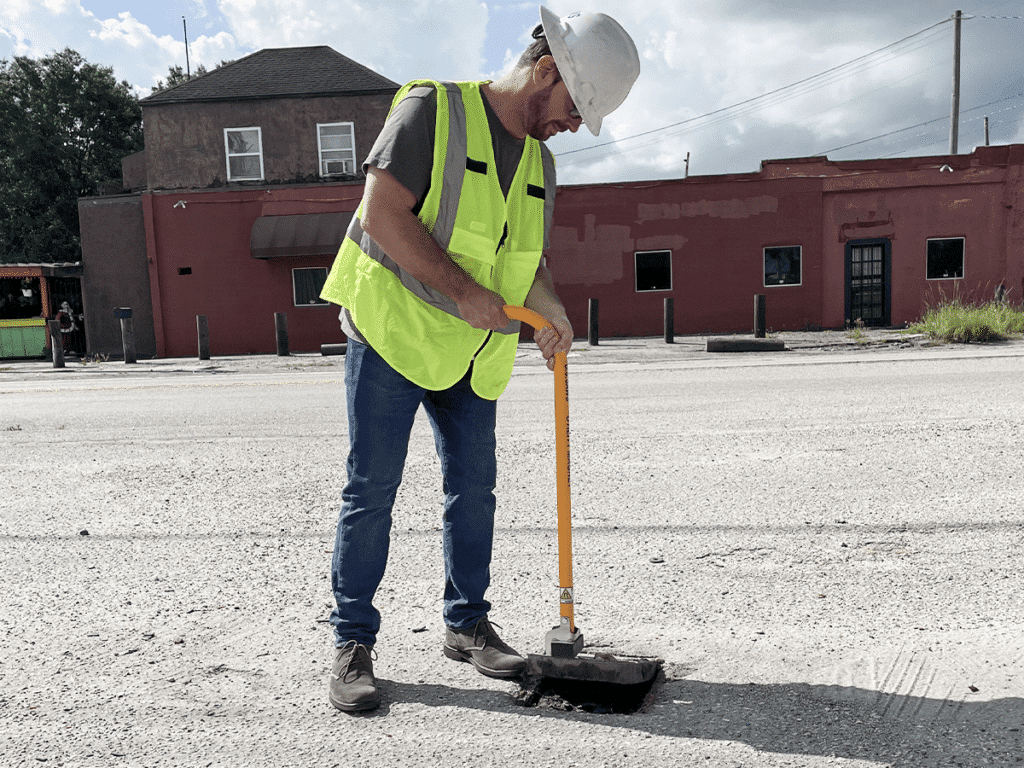
Step One: Access — The Bo Bop Magnetic Valve Box Lifter

A construction worker in a safety vest and helmet performs valve maintenance while using a tool to repair a pothole on a paved surface near a red building.

Before any valve can be exercised, the cover has to come off. That task sounds simple, but it accounts for a disproportionate share of field injuries. Prying lids with hooks or screwdrivers while crouched in a roadway is a recipe for smashed fingers, pinched toes, and strained backs.

The U.S.SAWS Bo Bop eliminates those risks by replacing the pry bar entirely. The tool features a 34-inch aluminum chassis in high-visibility safety yellow, with a powerful magnet housed in a 4″ x 2″ stainless steel base. The magnetic field is strong enough to penetrate textured lid surfaces and lifts covers up to 25 lbs cleanly from a standing position.

How It Works

Operation is straightforward and can be completed without bending or kneeling:

  1. Strike — If the lid is stuck or seized in its frame, use the solid metal end of the Bo Bop to strike the center of the cover and break it free.
  2. Place — Set the magnet on the center of the valve box lid. The magnetic field adheres through surface texture and minor debris.
  3. Lift — Pull straight up. The cover comes with it.
  4. Set Aside — Move the lid clear of the work area.
  5. Release — Twist and push the handle forward to break the magnetic bond and release the lid.

At only 8 lbs, the Bo Bop is light enough for a single operator to carry and use throughout a full maintenance route without fatigue. The ergonomic benefit compounds over the course of a work season eliminating repetitive bending across dozens or hundreds of valve box accesses adds up to a measurable reduction in strain.

The Bo Bop is designed for small water valve covers and metal electrical box covers the precise applications where crews are most likely to default to dangerous improvised methods.

“Every time a crew member bends down and pries off a lid with a screwdriver, that’s an injury waiting to happen. The Bo Bop is the kind of tool that makes you wonder why we ever did it any other way — it’s fast, it’s safe, and it pays for itself the moment it keeps someone off workers’ comp.”— Bill Glynn, President of Water & Sewer Sales, U.S. Saws

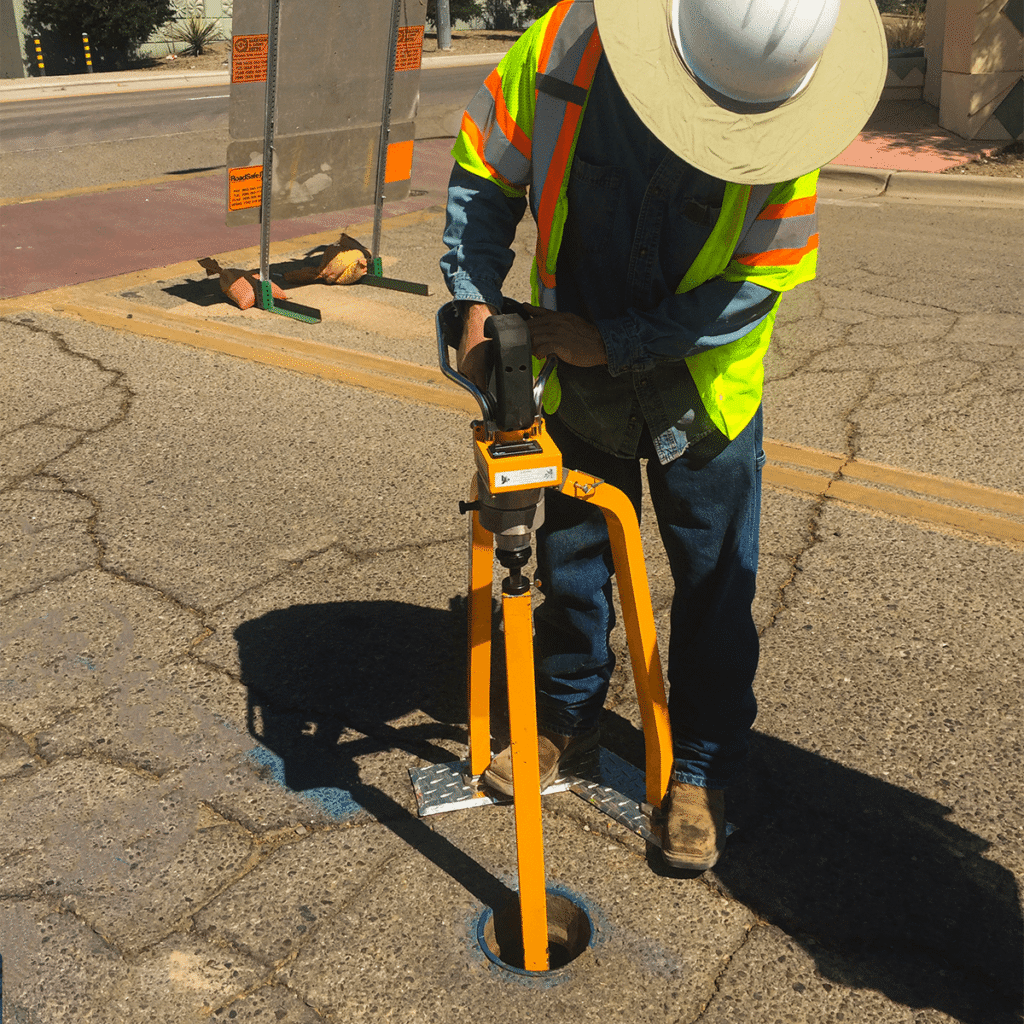
Step Two: Exercise — The VEX-400 Battery Powered Valve Exerciser

A construction worker in safety gear uses a core drill to make a circular hole in the asphalt of a road during daytime for valve maintenance.

With the cover removed and access established, the Valve Exerciser takes over.

The U.S.SAWS Valve Exerciser is a portable, battery-powered valve turning machine built specifically for municipal water departments, water and wastewater treatment facilities, and industrial facilities where regular valve cycling is a maintenance requirement. Its core function is opening, closing, and exercising valves, it is engineered to be performed with minimal manual labor and maximum operator protection.

Power and Torque

The Valve Exerciser produces up to 400 ft-lbs of peak torque through a torque-multiplying gearbox a critical design feature that allows the unit to achieve high output from an 18V Metabo battery platform. That gearbox is what separates the VEX-400 from battery-powered drills or impact drivers pressed into service as makeshift valve turners. It is purpose-matched to the Metabo motor; no aftermarket drill substitutions are supported.

For valves in good condition, a single battery can cycle approximately 30 twelve-inch valves on a full charge.

The package includes three 18V 5.2Ah lithium-ion batteries, providing enough capacity for a full day of field operations.

Reach and Adaptability

Valve depths vary significantly across aging infrastructure. The VEX-400 addresses this with an extension system:

  • Without extensions: Reaches depths from 8″ to 36″
  • With all included extensions (1 ft, 2 ft, 3 ft): Reaches depths from 8″ to 108″
  • Custom sizes: Available upon request for non-standard installations

The unit breaks down for transport and ships with a hard storage case, making it practical for service vehicles with limited bed space.

Safety Systems

The VEX-400 incorporates multiple operator protection features, particularly important when encountering frozen or severely corroded valves:

  • Trigger hand guard — Protects the operator’s hand during operation
  • Stable foot base — Provides a secure platform that resists torque reaction
  • Overload protection — Prevents motor damage under extreme load conditions
  • Shear key — A sacrificial mechanical fuse that breaks before the gearbox sustains damage, protecting the highest-cost component in the drivetrain

Turn Counter

The built-in rotation counter tracks turns in both the open and close directions. This feature is essential for compliance with valve maintenance programs that require verified full-cycle operation, and for identifying valves that may be partially obstructed or mechanically degraded.

The Complete Workflow: Why Both Tools Matter

The Bo Bop and the Valve Exerciser are complementary in function and philosophy. Both tools are engineered around the same core principle: the work crews perform every day should not injure them.

Bo Bop (US30398) VEX-400 (US75005)
Function Magnetic valve box lid lifter Battery-powered valve exerciser
Weight 8 lbs 45 lbs
Key Spec 25 lb lifting capacity 400 ft-lbs peak torque
Power Source No power required 18V Metabo Li-Ion (3 batteries included)
Reach / Depth 34″ handle 8″ – 108″ (with extensions)
Price $324.50 $6,739.40 (Deluxe Package)

Manual valve box access exposes workers to crush injuries and repetitive strain. Manual valve turning, especially on neglected valves exposes workers to sudden torque release, exhaustion, and back injury.

Addressing only one of these hazards leaves the other unresolved.

A crew equipped with both tools can execute a complete valve maintenance visit, remove the cover safely, exercise the valve fully, document turn counts, replace the cover without improvising any step of the process.

That standardization matters for safety compliance, for maintenance record accuracy, and for the longevity of both the infrastructure and the workforce.

“Water departments aren’t just buying two tools; they’re buying a complete valve maintenance program they can actually standardize. When your crew can handle every step from cover removal to turn count documentation without improvising anything, that’s not just safer, that’s justifiable.”— Bill Glynn, President of Water & Sewer Sales, U.S. Saws

For water departments building or upgrading their valve maintenance programs, the Bo Bop and VEX-400 together represent a complete solution to a workflow that has historically relied on physical strength and luck.

Why Smart Crews Are Ditching the Hook Bar for a Magnetic Manhole Lifter

Every utility worker knows the drill: walk up to a manhole, wedge a hook bar into the pick hole, brace your back, and yank. It’s how covers have been moved for decades. It’s also how thousands of backs have been wrecked, fingers have been crushed, and workers’ comp claims have piled up on job sites across the country.

There’s a better way, and it’s a lot smarter than a steel bar.

The U.S. Saws Break ‘N Take and Robotron magnetic manhole lifter systems have changed the game for utility crews who open manholes day in and day out. If you’re still doing it the old way, here’s everything you need to know about why these tools exist, how they work, and whether they’re right for your crew.

The Problem: Manual Manhole Lifting Is a Back Injury Waiting to Happen

Manhole covers are not light. Cast iron lids commonly weigh anywhere from 90 to 250 pounds or more. When a worker reaches down, wedges a hook into a pick hole, and pulls upward (often at an awkward angle, in a traffic zone, or in wet conditions) their lower back bears the full brunt of that load.

Research makes this sobering: surveys show that 25% of workers who perform manual material handling experience back pain lasting more than 7 days annually, 14% require medical attention, and 10% need time away from work. Back injuries account for more than 38% of all work-related musculoskeletal disorders, and the Bureau of Labor Statistics has found that over one million workers suffer back injuries each year, representing roughly one-fifth of all U.S. workplace injuries.

NIOSH (the National Institute for Occupational Safety and Health) uses a mathematical equation to assess lifting risk, and manhole covers score poorly on nearly every factor: extreme load weight, low and awkward starting position, limited hand coupling, and frequent repetition throughout a shift. Manual manhole lifting isn’t borderline risky. It sits firmly in NIOSH’s high-risk category.

Beyond back injuries, the traditional method creates pinch-point hazards when the cover shifts unexpectedly, trip and fall risk as workers step backward with a heavy load, and fatigue-related incidents as the task repeats dozens of times across a workday.

How a Magnetic Manhole Lifter Works

The U.S. Saws Break ‘N Take and Robotron systems use rare earth neodymium magnets, among the most powerful permanent magnets available, to attach directly to the surface of the manhole cover. No pick holes required. No bending, no yanking.

The process has six simple steps:

Step 1 — Remove from the protective shoe. The tool is stored in a non-magnetic shoe that disrupts the magnetic field during transport, preventing it from unexpectedly latching onto metal surfaces on the job site. When you arrive at the manhole, you pull the tool from the shoe and place the magnet base on the outer edge of the lid. Wipe the magnet surface clean before placing it. Debris reduces holding capacity.

Step 2 — Break the seal. The “break” function is what makes this tool genuinely clever. With the magnet engaged, you lower the handle so the breaking arm contacts the ground, then gently press the handle with your hands — no forceful kicking, no body weight slamming — until the edge of the lid frees itself from its seat. The fulcrum acts as a lever, directing mechanical advantage down and under the lid edge.

Step 3 — Lift to standing position. Once the lid breaks free, you raise the handle to a comfortable upright position. At this stage, you’re not lifting the full weight of the cover. The tool is designed to tilt and lift only the edge, leveraging the lid up enough to slide it clear of the opening.

Step 4 — Drag to a safe location. With the lid free of the seat, you drag it backwards away from the opening. The tool stays attached. You lower the handle to the ground so it can’t tip over unexpectedly.

Step 5 — Release. To detach, lift the handle to its full upright position until it contacts the stopping pin, then push it against the stop in a quick, forceful motion. The magnets disengage, the tool tips back, and a sharp lift from the fulcrum fully releases it from the lid.

Step 6 — Return to the shoe. The tool goes back into the protective shoe for transport to the next location.

The Robotron operates similarly but uses a pivot-based three-position system — lifting, sliding, and removal — giving the operator more precise mechanical control at each phase of the operation. The Utility Robotron version adds an extendable handle, allowing taller operators or those who need extra working distance from the opening to operate even more comfortably.

Choosing the Right Manhole Lid Lifter: 3-Magnet vs. 4-Magnet, Standard vs. Utility

U.S. Saws offers the system in two product families across a capacity range from 150 lbs up to 325 lbs.

The Break ‘N Take is the entry-level system, offered in orange, and comes in two configurations:

  • 3-Magnet (Part No. US30178): 150 lb capacity, 15 lbs unit weight, 10″ x 5″ base
  • 4-Magnet (Part No. US30188): 225 lb capacity, 17 lbs unit weight, 10″ x 5″ base

The Break ‘N Take line is ideal for lighter residential or municipal covers that include standard water meter lids, smaller sewer access points, and utility vaults in lower-traffic environments.

The Robotron is the heavy-duty version, offered in yellow, with four configurations:

  • 3-Magnet Robotron (US30178RT): 250 lb capacity, 15 lbs unit weight, 13″ x 6″ base, 34″ height
  • Utility 3-Magnet Robotron (US30178UTILITY): 275 lb capacity, 19 lbs unit weight, 13″ x 6″ base, 42″ height
  • 4-Magnet Robotron (US30188RT): 300 lb capacity, 18 lbs unit weight, 16″ x 7″ base, 34″ height
  • Utility 4-Magnet Robotron (US30188UTILITY): 325 lb capacity, 22 lbs unit weight, 16″ x 7″ base, 42″ height

The difference between the standard and Utility versions is the handle: the Utility models have an extendable handle that raises the unit height from 34″ to 42″, giving taller workers a more ergonomic grip and giving crews in confined traffic zones extra distance between themselves and the open hole. For most municipal waterworks, wastewater, or telecom crews dealing with heavy cast iron street covers, the 4-Magnet Robotron at 300 lbs capacity covers the vast majority of real-world applications. The Utility 4-Magnet maxes out at 325 lbs for the heaviest infrastructure-grade covers found in high-load traffic zones.

One important note from the manual: the rated capacities are based on a clean, flat steel iron surface. Covers in the field will often be uneven or coated, which can reduce effective holding strength, so when in doubt, choose the higher capacity model.

One Worker. One Tool. Done.

Perhaps the most significant operational benefit of these systems is the manpower equation. A traditional hook bar or pry bar method for a heavy cover often requires two workers: one to lift the edge, one to guide or support the cover as it’s moved. With the Break ‘N Take or Robotron, a single properly trained operator can safely lift, slide, and reposition a manhole cover without assistance.

That changes crew sizing, especially for municipalities and contractors running tight field teams. Fewer workers needed for routine access means more people available for the actual work. On a crew that opens and closes dozens of manholes a day, the time savings compound quickly.

“One of our customers put it best — they said before the Robotron, every cover took two guys. Now one operator handles it solo, stays upright the whole time, and the second crew member is actually free to work. Over a week, that adds up to hours of recovered productivity. And nobody’s icing their back at the end of the shift anymore.” Brandon Utesch, Western Sales Manager, Water Works Division, U.S. Saws

Manhole Lifter Safety, Ergonomics, and OSHA Compliance

The manual is explicit about something important: the tool is designed to lift only the edge of a manhole cover so the lid can be slid off, not to suspend the full weight of the lid in the air. This is a deliberate safety design choice.

In terms of ergonomic improvement, the tool essentially eliminates the worst part of the manual method: the low-angle, high-load, awkward pull. Instead of stooping and yanking, the operator stands upright and uses controlled lever force. That directly addresses the posture, load weight, and coupling factors that make manual manhole lifting so risky under NIOSH guidelines.

There are a few safety factors crews need to be aware of:

  • Magnetic field hazards: The neodymium magnets in these tools are powerful. The tool must be kept at least 36 inches away from persons with pacemakers or other medical implants; the magnetic field can interfere with device function, with potentially life-threatening consequences. Credit cards, electronic devices, and metal tools should also be kept clear.
  • Pinch points: Strong magnets and ferrous metal create sudden, unexpected attraction forces. Workers should always be aware of their hands and feet when placing or removing the tool.
  • Proper technique matters: Using sharp, jerky tugging motions during removal can cause the magnets to release unexpectedly. The manual recommends a stable body stance so that if the tool does release, the worker doesn’t fall backward.
  • The tool does not replace the need for PPE: OSHA-compliant foot protection, eye protection, gloves, and appropriate clothing are all still required. What it does do is remove the highest-risk manual lifting component from a task that OSHA and NIOSH have long identified as a leading source of musculoskeletal injury in utility work.

“Training only gets you so far. The moment someone’s tired or running behind, all that proper lifting technique goes out the window. What actually protects workers is removing the hazard entirely — and that’s exactly what a magnetic lifter does. OSHA calls it engineering controls. We call it the right way to do it.” – Brandon Utesch, Western Sales Manager, Water Works Division, U.S. Saws

Which Industries Benefit Most from a Magnetic Manhole Lifter?

Any trade that regularly accesses below-grade infrastructure is a natural fit:

  • Municipal water and wastewater utilities are the most obvious application. These crews open manhole covers multiple times per day, year-round. Reducing cumulative back stress for these workers has direct impact on injury rates and long-term workforce health.
  • Electrical utilities maintaining underground distribution networks encounter similar covers and face the same lifting challenges.
  • Road construction and paving crews often need to adjust cover elevations or access utility connections mid-project, frequently under traffic control conditions where speed and minimal crew disruption matter.
  • Traffic zones are where this tool especially proves its value. In live traffic lanes, you don’t want workers bent over a cover for extended periods. The upright operating posture means the worker can keep eyes up, stay situationally aware, and complete the task faster.

Manhole Lifter Maintenance, Durability, and What to Expect Long-Term

The magnets themselves are a non-issue for maintenance. The system uses rare earth neodymium magnets, the same technology that has become standard across industrial applications, and these magnets do not lose their magnetic strength over time under normal use. There’s no battery, no hydraulic fluid, no motor. The magnet is the mechanism, and it’s effectively permanent.

Day-to-day care is straightforward: wipe the magnet faces clean before each use to remove dirt, asphalt residue, and debris that would reduce contact area and holding capacity. The protective shoe should be used every time the tool is transported to prevent unintended attraction to metal surfaces or other tools in the truck.

Beyond keeping it clean, inspect the handle joints and pivot points for wear, check that the stopping pin functions correctly and ensure the tool isn’t damaged or modified. Modifications void the warranty and, more importantly, can compromise the structural integrity of the lever system.

The one-year warranty covers defects in materials and workmanship under normal use. Given that the system has no consumable parts: no blades, no fluids, no electronics, the realistic service life of a well-maintained unit running daily in a utility crew environment is measured in years, not months.

The Bottom Line

The U.S. Saws Break ‘N Take and Robotron magnetic manhole lifter systems address a problem that’s been quietly grinding through utility workforces for generations: heavy covers, bad angles, and backs that give out years before retirement. The technology is simple: magnets, a lever, and good mechanical design.

The impact on crew safety, efficiency, and long-term health is significant.

If your crew is opening manholes regularly, the question isn’t really whether you can afford one of these. It’s whether you can afford not to have one.

View the full Break ‘N Take and Robotron lineup at U.S. Saws.

STAY SHARP!


Sign up to receive the latest info on new U.S.SAWS products, special offers and more. Enter your information below to subscribe to our email list.

© 2026 U.S.Saws All Rights Reserved. Website Designed And Developed By Power On Marketing