The One Man Polymer Pump: A Joint Filler Pump Built for Real Production

If you’re still filling concrete floor joints with hand-squeezed cartridges or running a two-man pump operation, you’re leaving money on the table. The U.S. Saws One Man Polymer Pump (SX20552) is a dual-component joint filler pump designed for one-person operation — and once contractors run the numbers, most don’t go back.

In this blog, we discuss how the One Man Polymer Pump works, what makes it a true one-person operation, the production numbers contractors can expect, and why the machine pays for itself faster than most expect.

How the One Man Polymer Pump Works

The One Man Polymer Pump is straightforward in concept. Part A resin loads into one 6.5-gallon tank, Part B into the other. The machine pumps both components down through separate lines to a metal manifold, where they meet and are channeled into a disposable static mixer. By the time the material reaches the tip, it’s thoroughly combined and ready to inject directly into the joint, where it cures solid.

Setup from unpacking to first dispense runs about 30 minutes once an operator gets comfortable with the machine — less for experienced crews. The pump handles polyurea and epoxy joint fillers at 1:1 ratio, and will also dispense certain polyaspartic coatings. It is not compatible with silicone sealants.

What Makes It a One-Man Operation

The “T” handle is the key. It’s designed for both left- and right-handed use, positioned so the operator can pull the cart along with one hand while controlling the dispense handle with the other. That’s it — one person moves the machine and controls material flow simultaneously.

The practical result: the rest of the crew stays productive on other tasks instead of shadowing the pump operator. And because the operator always knows exactly where the pump is relative to freshly filled joints, there’s no risk of rolling back over wet material — a real problem with traditional two-man setups.

The strapped-on waste bucket takes care of another common headache. Instead of dripping uncured resin across the floor while repositioning between joints, the operator holds the mixing tip over the bucket during transit. No material on the floor, no cleanup with acetone and rags.

At 175 lbs, the machine isn’t a one-man lift — but that’s not how it’s typically moved. Most operators roll it up a tilt-down trailer ramp, which a single person can handle without help. Once it’s on the floor, the four-wheel design maneuvers easily.

A Joint Filler Pump And The Numbers That Matter

On a well-cleaned joint in open space, one operator can walk the machine at 75 feet per minute while dispensing. As Dave Glynn, Owner of U.S. Saws puts it: “One guy on a well-cleaned joint that’s in a wide-open space can walk with the machine at about seventy-five feet per minute while it’s dispensing.” The machine’s flow rate is approximately 1 gallon per minute, which keeps pace with that walking speed without over-applying material.

For material coverage, the math works out to roughly 600–700 linear feet per 10-gallon load on a standard joint profile (1.5″ deep × 0.187″ wide). The 6.5-gallon tanks hold a full 5-gallon bucket of material per side with reserve — so operators aren’t stopping to refill the moment a bucket runs dry. They load a full pail, run until they see the level dropping, and have time to prep the next bucket without a hard stop.

A good contractor pre-measures joint depth and width on a test section before ordering material, then adds a buffer. Excess carries to the next job. No one gets caught short mid-floor.

Polymer Pump Power Options

The pump runs on 115V standard power. On most commercial jobsites, that means running a cord — workable, but not always ideal across a large warehouse floor.

The more popular setup is cord-free: the machine’s built-in storage space fits either a Honda EU1000i, a Predator 2000 generator, or a deep-cycle battery paired with an inverter. If you’re going the battery route, a Group 27 Deep Cycle Battery is the recommended spec — the unit does not come with a battery, and U.S. Saws will install the inverter for you if requested at the time of order. Battery-and-inverter operation is particularly useful in occupied facilities where generator exhaust or noise is an issue. A 220V version is available as a special order for operations that need it.

Built-In Design Details That Save Time

Several features on the SX20552 address specific field frustrations that operators of older pump designs will recognize immediately.

The two-position wand holder has a standard operating position and a dedicated cleaning position — a small thing that makes end-of-day maintenance faster and more consistent. The redesigned diamond head manifold makes line removal easier, which matters when you’re doing a proper daily flush. The three-bolt pump change system means faster service when a pump needs to be swapped in the field.

The semi-transparent polyethylene tanks let operators monitor fluid levels on the fly without stopping to check. Removable debris screens protect the pumps from contamination, and the tanks are inexpensive to replace if needed. The spill cover over the motor protects both the machine and the floor from dripped or spilled material during operation.

The ROI Case For the One Man Polymer Pump

The pump lists under $7,000. That number gives some contractors pause — right up until they run the math.

Hand cartridges typically cost $15–20 each and cover around 20–30 linear feet. On a 5,000-foot job, that’s hundreds of cartridges and thousands of dollars in material cost alone, plus the labor of two or more people squeezing tubes all day. Bulk 5-gallon kits — what the One Man Pump is designed to run — cost significantly less per unit of coverage.

The crossover happens faster than most expect. After a few thousand linear feet of joint, the difference in material cost alone begins to offset the machine purchase. After that, the labor savings are pure margin. Contractors who do regular commercial floor work typically see payback within a handful of jobs.

A Polymer Pump Built to Last

The pumps inside the SX20552 aren’t off-the-shelf hydraulic components. U.S. Saws worked directly with the pump manufacturer to custom-build them for this specific application — addressing failure modes common in standard hydraulic pumps when running polyurea and epoxy materials. The result is a pump that handles the shear-thickening properties of these materials without the restriction and buildup issues that plague generic designs.

With proper maintenance, the pumps last approximately 5,000 gallons of material before wearing to the point of reduced output — roughly 500 full loads, which translates to years of regular use for most operations. The frame, tanks, and lines are built to outlast the pumps by a wide margin. The machine carries a one-year warranty against defects in material and workmanship under normal use.

Maintenance Keeps the Machine Profitable

The biggest mistake new operators make is skipping the end-of-day purge. Leaving material in the lines overnight without flushing can result in a fully cured system from tank to tip. Replacing everything on one side runs close to $1,000 in parts plus labor — far more than the 15–20 minutes a proper flush takes.

That maintenance protocol, and what it actually involves, is covered separately in our guide to cleaning and maintaining the One Man Polymer Pump. Doing it right consistently is the difference between a machine that lasts years and one that becomes an expensive problem.

Who Is the One Man Polymer Pump For

The One Man Polymer Pump is built for commercial and industrial floor contractors doing regular joint filling work — warehouse floors, distribution centers, manufacturing facilities. An optional 2:1 sprocket kit is available for materials requiring that mix ratio.

It’s not the right tool for a contractor doing occasional small jobs who hasn’t yet built volume. For those situations, cartridges are still practical. But for anyone filling joints as a regular part of their business, the pump pays for itself and then keeps paying.

The machine is backed by U.S. Saws’ technical support and a network of distributors nationwide. For questions, specs, or to place an order, contact U.S. Saws directly.

A Guide to Hand-Held Saws for Utility Work

In demanding utility environments, crews rely on innovative construction equipment designed to perform where traditional tools fall short.

Concrete hand saws — including air-powered and hydraulic-powered models — are engineered for precision, control, and safety on the job.

These portable saws are built for cutting concrete, masonry, and ductile-iron pipe in environments where traditional gas tools may pose risks or limitations.

Whether working in confined spaces, cutting pipe in trenches, or making deep cuts in reinforced concrete, these hand-held saws deliver the versatility and durability contractors in the utility and infrastructure industries depend on every day.

In this blog, we explore how air-powered and hydraulic hand saws are used in utility and construction applications, the benefits of each design, and what to consider when selecting the right saw for your next project.

What Is a Hand-Held Saw?

A hand-held saw is a portable concrete cutting tool designed for jobs where control and maneuverability matter as much as power. Unlike walk-behind saws or wall saws, a hand held saw allows operators to make vertical or overhead cuts, work in tight trenches, and complete precise openings without large equipment. These saws are frequently used by utility and municipal crews performing water-main, sewer, or repair work, where the ability to operate safely in damp or confined environments is essential.

Air-Powered Hand-Held Saws

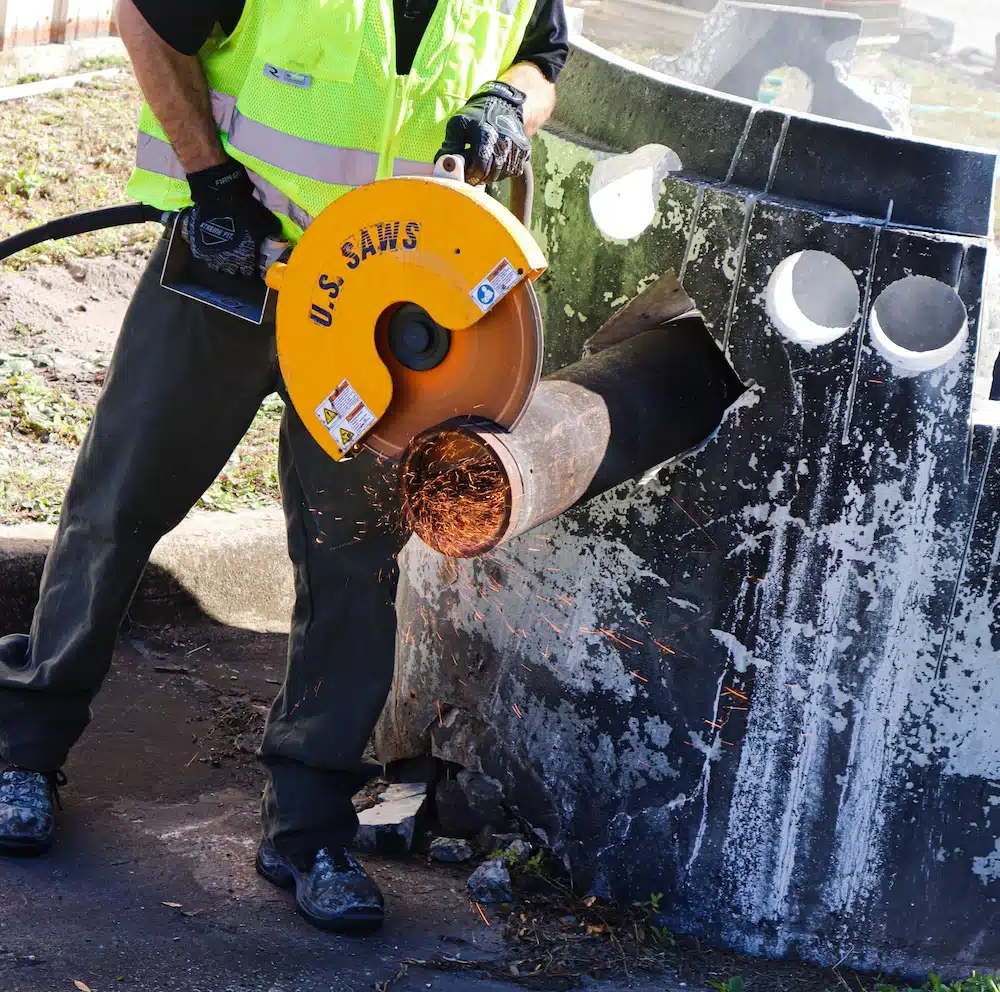
Air-powered saws like the U.S. Saws HS-125 provide a clean, spark-free alternative to gas-powered chop saws. Powered entirely by compressed air, they emit no exhaust fumes and require minimal maintenance.

Typical applications include:

  • Cutting concrete or ductile-iron pipe in trenches or vaults
  • Performing interior or confined-space cutting where ventilation is limited
  • Utility or wastewater work where electrical or fuel ignition risks are present

Because compressed air keeps the motor cool and prevents sparking, air-powered saws are a reliable choice for underground and municipal projects. They’re lighter than many hydraulic units, start instantly, and can be paired with diamond blades designed for fast, smooth cuts.

Hydraulic Hand-Held Saws

Hydraulic-powered saws, such as U.S. Saws’ 24-inch Hydraulic Hand Saw, are engineered for heavy-duty concrete and pipe cutting. Driven by a separate power unit supplying pressurized hydraulic fluid, these saws deliver exceptional torque and blade speed for demanding applications.

Key features include:

  • Fully welded aluminum frame for durability
  • Dual-position front handle for control
  • Up to 10-inch cutting depth for deep concrete or masonry work
  • High-efficiency motor operating at 12 GPM @ 2500 PSI

Hydraulic hand saws are ideal for water- and sewer-line installation, structural concrete removal, and deep utility access cuts. They excel in wet environments because they use water for cooling and dust suppression while operating safely without electricity or exhaust.

Choosing the Right Blade for a Concrete Hand Saw

Performance depends as much on the blade as on the saw itself. U.S. Saws manufactures a range of diamond blades engineered for professional cutting.

When selecting a blade, contractors should consider:

  • Material type: Harder bonds for abrasive materials like concrete and asphalt; softer bonds for dense materials like tile or stone.
  • Cutting style: Segmented blades for aggressive speed, turbo-rim designs for balanced control, and multi-purpose blades for mixed materials.
  • Wet cutting: Always recommended for concrete and masonry to reduce heat, extend blade life, and control silica dust.
  • Wet-cutting practices are especially important for safety and compliance. For additional guidance, see The Do’s and Don’ts of Wet Tile Cutting with Diamond Blades

Safety and Best Practices

Operating a concrete hand saw safely requires attention to both environment and equipment.

Contractors should:

  • Verify that guards, hoses, and couplings are secure before starting.
  • Match blade RPM ratings to the saw’s operating speed.
  • Use continuous water flow when wet cutting to minimize airborne silica.
  • Inspect hydraulic hoses or air lines for wear or leaks.
  • Wear PPE — safety glasses, gloves, hearing protection, and respirators.

Follow OSHA’s Hand and Power Tools safety guidance for proper training and tool inspection.

By adhering to these steps, crews can improve productivity while meeting job-site safety standards.

Why Contractors Choose U.S. Saws

For more than 30 years, U.S. Saws has developed specialty cutting equipment that meets the real-world needs of construction and utility professionals. The company’s air-powered and hydraulic concrete hand saws combine portability, torque, and safety features that allow crews to work efficiently in challenging conditions.

Many models are manufactured in the U.S.A. and supported by product training, on-site demonstrations, and customer service from experts with decades of field experience.

Explore the complete selection of hand-held concrete saws and diamond blades at U.S. Saws to find the right tool for your next project.

A Look At Air Saws for Heavy-Duty Cutting

On construction and utility job sites, crews often face materials that standard tools struggle to cut. An air saw, also known as a pneumatic saw, is designed to meet that challenge. Pneumatic simply means powered by compressed air, a system that provides consistent energy without cords, batteries, or fuel.

Because of this unique design, air saws perform reliably in environments where electric or gas-powered saws may be impractical. They reduce risks of sparks, overheating, and electrical hazards, making them a trusted choice for projects involving concrete, asphalt, ductile iron, and large-diameter pipe.

This article looks at the history of pneumatic saws, the main types of air saws in use today, and the reasons they remain a preferred tool on demanding job sites.

A Brief History of Air Saws

Air saws emerged as part of the broader use of pneumatic tools in the early 20th century.

Factories, shipyards, and mines relied on compressed air systems because they eliminated the fire hazards associated with electricity and sparks. This made them invaluable in industries working with fuel, chemicals, or explosive dust.

As infrastructure expanded, these saws became more specialized. By the mid-20th century, water and sewer departments used air chain saws and belly saws to cut ductile iron pipe underground, where gas-powered tools were unsafe. In roadwork, walk-behind saws proved reliable for trenching, curb cutting, and asphalt repair, especially in wet or dusty conditions where electric saws often failed.

Types of Pneumatic Saws

Air saws come in several forms, each designed for specific job site requirements:

Hand-Held Air Powered Saws:

Portable and precise, used for cutting ductile iron, steel, or reinforced concrete where mobility is important.

Walk-Behind Air Saws:

Stable and powerful, common in roadwork and municipal projects for trenching, asphalt repair, and concrete slab cutting.

Air Chain Saws:

Purpose-built for ductile iron pipe, producing clean cuts without sparks — ideal for waterworks and underground utility crews.

Air Powered Belly Saws:

Specialized for large-diameter pipe, offering safe and efficient cutting for municipal water, natural gas, and infrastructure projects.

Why Air Saws Are Preferred on Job Sites

Pneumatic saws combine safety, consistency, and durability. Crews value them because they:

  • Deliver steady cutting power from compressed air
  • Operate safely in environments with fire or electrical risks
  • Perform reliably in wet, dusty, or variable conditions
  • Provide long service life with proper maintenance

The Occupational Safety and Health Administration (OSHA) highlights pneumatic tools as widely used in construction because they reduce electrical hazards and the risks of sparks. These qualities explain why air saws remain a mainstay in demanding environments.

In addition to safety, they support productivity. Air saws operate without overheating, reduce downtime, and help extend blade life. Over time, this reliability translates into efficiency gains and lower costs for contractors and municipalities.

Safety Considerations

While air saws eliminate many risks associated with electric or gas tools, proper handling is essential. Best practices include:

  • Air Supply: Use a compressor that meets the saw’s requirements for pressure and volume.
  • Blade Selection: Match blades to the material being cut to prevent wear or kickback.
  • Work Area: Secure pipes or clear debris from surfaces before cutting.
  • Protective Gear: Wear safety glasses, hearing protection, and dust masks.
  • Hose Management: Keep hoses away from sharp edges and heavy traffic.
  • Maintenance: Regularly inspect and lubricate moving parts to extend tool life.

U.S. Saws and Air Saw Development

U.S. Saws manufactures and supplies air saws and other specialty tools designed for the construction industry. With more than 30 years of experience in concrete repair and tool design, we design equipment that improves both safety and productivity on job sites.

Explore our complete selection of air saws and specialty tools to learn more about the options available for you.

Tile Saws in Concrete Drilling and Cutting Applications

Concrete and masonry contractors depend on tools that deliver both accuracy and reliability. In heavy-duty environments, where every cut impacts productivity and safety, even small precision tools play a critical role. Tile saws are one of those tools—built to provide controlled, straight cuts on dense materials where larger saws may not be practical.

Although the term “tile saw” often brings to mind ceramic work, professional-grade models are also used for concrete drilling and cutting tasks that require precision, stability, and wet-cutting performance.

In this blog, we explore how tile saws fit into concrete and masonry applications, which diamond blades perform best, and what safety practices contractors should follow on the job.

What Is a Tile Saw?

A tile saw is a stationary cutting tool designed to make straight, accurate cuts using a diamond blade. The continuous flow of water cools the blade, reduces airborne dust, and improves both safety and blade longevity.

While hand-held or walk-behind saws handle larger, deeper cuts, tile saws are chosen for controlled, shallow, or detailed cuts on hard materials. In job site conditions, they can be used to:

  • Trim or size small sections of cured concrete or masonry.
  • Cut pavers, block, or tile-based materials used in utility or repair work.
  • Prepare small components or samples for concrete testing or patching.

Their compact, bench-style design allows for better control when accuracy is more important than speed.

Tile Saws and Diamond Blades

The performance of any tile saw depends on the diamond blade selected.U.S. Saws manufactures a full range of diamond blades engineered for the construction industry, including turbo and multi-purpose designs commonly used in tile saw and precision cutting applications.

  • Turbo Diamond Blades: Offer a faster cut with moderate smoothness—used when efficiency and control must balance.
  • Multi-Purpose Blades (like The General or Dos Seggie series): Built to handle a variety of materials including masonry, concrete, and stone, reducing the need to switch tools on site.

Contractors should always verify the bond hardness of the blade against the material being cut. Harder bonds perform best on abrasive materials such as concrete, while softer bonds work better on harder, dense materials like tile or stone.

Wet Cutting for Safety and Performance

Wet cutting is essential for extending the life of a diamond blade and maintaining safety on the job. The continuous water feed reduces friction, keeps the blade cool, and suppresses silica dust—a key OSHA safety requirement for construction sites.

Regular inspection of both the saw and the blade ensures safe operation. Contractors should check for glazing, uneven wear, and confirm that the water delivery system is functioning properly before use.

For further safety guidance, refer to OSHA’s Safe Use of Portable and Hand-Held Power Tools.

Tile Saw Safety Best Practices

Even though tile saws are smaller than walk-behind or air-powered models, they must still be handled with care.

To protect crews and equipment, contractors should:

  • Match the saw’s RPM to the blade’s rated speed.
  • Always use a water source when cutting dense materials.
  • Secure workpieces to prevent shifting during operation.
  • Keep electrical connections clear of water and debris.

Wear proper PPE, including safety glasses, hearing protection, and respirators for dust control.

Following these practices supports OSHA compliance and helps crews maintain consistent performance across concrete cutting operations.

Why Contractors Choose U.S. Saws

With more than 30 years of experience designing tools for the construction and utility industries, U.S. Saws delivers cutting equipment built for productivity, safety, and durability. From turbo and multi-purpose diamond blades to general-use options, U.S. Saws manufactures tools that perform reliably in concrete drilling and cutting environments.

Explore the complete selection of diamond blades and cutting tools at U.S. Saws to find the right equipment for your next project.

Walk Behind Saw: How to Use One Safely and Effectively

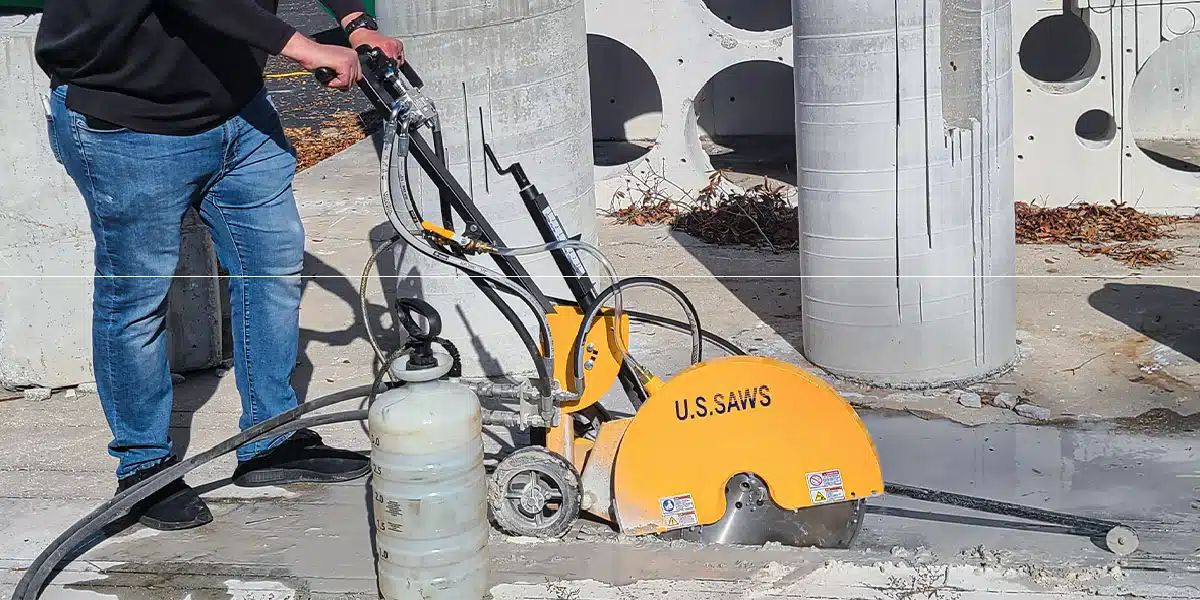
A walk behind saw is one of the most essential tools for those who need to cut through sidewalks, roads, driveways, or large concrete slabs. Unlike smaller handheld models, a heavy duty walk behind saw is designed for long, deep, and precise cuts. Contractors rely on these saws for everything from expansion joints to patch repairs, and their efficiency makes them a staple on construction sites.

What Is a Walk Behind Saw?

A walk behind saw for concrete is a large cutting machine mounted on wheels that allows the operator to guide the saw steadily across a surface. Powered by gas, diesel, air, hydraulic, or electricity, these saws use diamond blades or other specialized saw blades to cut through concrete, asphalt, stone, and other hard materials. Because of their stability and cutting depth, walk behind saws are the preferred choice for heavy-duty jobs where handheld tools fall short.

How a Walk Behind Saw Works

The power of a concrete walk behind saw comes from its motor and blade combination. Most saws use water to cool the blade and reduce harmful silica dust while cutting, which is an OSHA requirement for many applications. By adjusting the depth controls, operators can make cuts up to 7.5 inches deep, depending on the blade size and model.

Contractors often describe these machines as “push saws” because the blade pulls the saw forward during cutting, while the operator guides it smoothly along the cut line.

Benefits of Using a Walk Behind Saw

There are multiple benefits of using a walk behind saw, including:

  • Deeper cuts: A walk behind saw for concrete can reach depths handheld saws cannot, making it ideal for thick slabs and pavement.
  • Cleaner lines: The weight and stability of the saw reduce vibration, ensuring straighter cuts.
  • Efficiency: Projects are completed faster compared to using multiple passes with a smaller saw.
  • Less operator fatigue: Because the machine carries its own weight, operators exert less energy than with handheld tools.

Common Uses for Walk Behind Saws

Walk behind saws are a versatile tool. However, these tools are most often used for difficult jobs, including:

  • Cutting expansion joints in newly poured concrete.
  • Repairing or removing damaged sidewalks and driveways.
  • Cutting trenches for plumbing, electrical, or utility installation.
  • Roadwork and asphalt patching.
  • Industrial flooring in warehouses and factories.

How to Use a Walk Behind Saw Safely

Knowing how to use a walk behind saw correctly is critical for both performance and safety. OSHA emphasize several key safety measures:

  • Wear proper PPE: Safety glasses, gloves, ear protection, and a respirator or dust mask if dry cutting .
  • Control dust: Use wet cutting whenever possible to minimize exposure to silica dust .
  • Check the blade: Always use the correct blade for the material, and never operate a saw with a damaged blade.
  • Operate steadily: Start the saw, open the water valve, lower the blade slowly into the surface, and guide the machine without twisting or forcing direction.
  • Ventilation: Only use fuel-powered saws outdoors or in well-ventilated spaces to prevent carbon monoxide buildup.

Following these precautions ensures safe operation and compliance with OSHA standards for power tools and silica exposure .

Choosing the Right Walk Behind Saw

When considering a walk behind, you should evaluate:

  • Power source: Gas or diesel models for outdoor heavy-duty work, electric models for indoor jobs.
  • Blade compatibility: Match the saw to the correct diamond blade type for the material.
  • Cutting depth: Consider the maximum depth required for your projects.
  • Jobsite conditions: Indoor/outdoor environment, dust regulations, and ventilation.

U.S. Saws offers a range of heavy duty walk behind saws for sale built to meet the demands of today’s contractors.

Frequently Asked Questions About Walk Behind Saws

What is a walk-behind saw?

A walk-behind saw is a large cutting machine on wheels that allows an operator to cut concrete or asphalt with stability and precision.

How deep can a walk-behind saw cut?

Most walk-behind saws cut between 7 and 24 inches deep, depending on blade size and power.

How do you start a walk-behind concrete saw?

Start-up varies by model, but generally involves checking the blade, ensuring fuel or power is connected, engaging the water system, and lowering the blade slowly into the surface. Always follow manufacturer instructions.

What is a rotating saw called?

A rotating saw is commonly called a circular saw. With a diamond blade, circular saws can cut concrete, though deeper cuts require a walk behind saw.

Final Thoughts on Concrete Walk Behind Saws

A walk behind saw is the contractor’s choice for durability, depth, and precision. From sidewalks to roadwork, these machines save time, reduce operator strain, and deliver professional results.

If you’re considering adding one to your toolkit, explore U.S. Saws’ collection of walk behind saws for sale and diamond blades to find the right solution for your next project.

STAY SHARP!


Sign up to receive the latest info on new U.S.SAWS products, special offers and more. Enter your information below to subscribe to our email list.

© 2026 U.S.Saws All Rights Reserved. Website Designed And Developed By Power On Marketing